


France’s Unrest: Who Was Protesting, and Who Was Behind the Violence?



.png )
Scenes of destruction can define how a protest is remembered. But understanding France’s unrest requires distinguishing peaceful demonstrators from those responsible for violence and examining the competing accounts of what happened.
News 1st | News Analysis | 18 October 2026
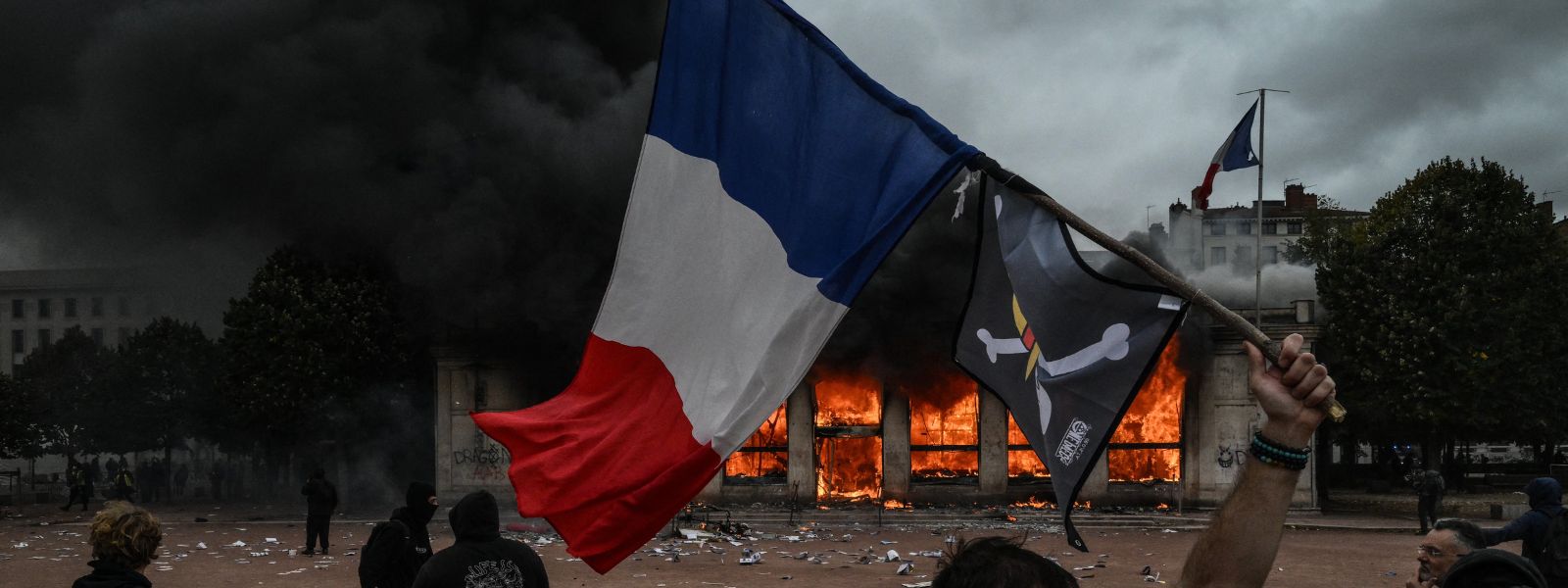
Yesterday, News 1st carried images of violence and unrest in France: burning vehicles, damaged buildings and confrontations on the streets.
Viewed together, those scenes could easily have left audiences with the impression of a massive youth uprising: an entire generation taking to the streets in violent revolt.
But that impression deserves closer examination. Images can accurately capture individual acts of violence without accurately representing everyone who joined a demonstration.
For Sri Lankan audiences watching the recent protests supporting Ven. Gnanasara Thero, the importance of looking beyond dramatic visuals is close to home. The circumstances differ, but the questions matter equally: who is protesting, what are they demanding, and whose views do they represent? This is why News 1st is taking a closer look at France: to understand the events beyond the images and the narratives offered by organisers, political figures and authorities.
Today, we examine who was protesting, who was involved in destruction, and whether the two have too readily been treated as one.
Reporting by Reuters, Associated Press and Le Monde distinguishes largely peaceful demonstrations from groups engaged in confrontation and looting. That distinction challenges any account that treats the crowds as a single body with a common purpose.
This does not mean young people were absent from the violence. It means young protesters cannot collectively be held responsible for it.
What brought people onto the streets?
Saturday’s mobilisation brought together concerns about rising living costs, public services and education.
Associated Press reported the participation of student organisations and trade unions, with demonstrators also demanding better wages and pensions. The protests represented a range of grievances and participants, rather than a single organisation or constituency.
Reuters described the movement’s beginnings in protests over school conditions and teacher shortages, before it broadened into opposition to inequality, spending cuts and economic hardship. Its reporting distinguished peaceful marchers from violent groups targeting shops, public buildings and police.
These grievances are essential to understanding the mobilisation. Explaining them does not excuse the destruction. It establishes why people demonstrated in the first place.
Who was involved in the violence?
French authorities have blamed radical far-left groups and criminal elements.
Associated Press quoted Interior Minister Laurent Nuñez describing “extremely violent, radical far-left groups” and saying they had been joined by people seeking to loot shops. Those statements represent the government’s assessment; they should not be confused with judicial findings establishing individual responsibility.
Le Monde’s street reporting described a more varied picture: organised far-left groups, students and other participants, alongside opportunistic looters. It distinguished large crowds demonstrating from separate groups seeking confrontation.
The evidence therefore does not support either sweeping conclusion: that young protesters as a whole were responsible, or that young people played no part in the violence.
Nor does the reporting reviewed establish a single organisation directing every episode of disorder.
Age, presence and responsibility are separate questions. Being young does not establish culpability. Being present at a demonstration does not establish participation in a crime. Equally, legitimate political demands cannot absolve individuals who commit violence.
Police tactics are also part of the story
An examination of responsibility must include the conduct of law enforcement.
Le Monde has documented serious injuries to teenagers during the preceding student mobilisation and investigations into police interventions. Its reporting has also examined concerns that confrontational policing could intensify tensions.
In its coverage of Saturday’s events, the newspaper described fragmented confrontations, overstretched police units and questions about crowd management. Those observations are relevant to understanding how disorder developed. They do not establish that authorities secretly orchestrated the violence.
Allegations of excessive force deserve investigation. So do attacks on officers, destruction of businesses and damage to public property.
Accountability should follow evidence, regardless of who is implicated.
Who gets to define a protest?
Beyond the confrontations lies another contest: the struggle to determine what the public believes the protests represent.
Organisers may emphasise unity, peaceful intentions and the legitimacy of their demands. Authorities may emphasise threats to public order. Political opponents may interpret events in ways that support their own arguments.
These interests warrant scrutiny. They do not automatically make any account false.
A movement’s organisers cannot establish the motives of everyone who appears in a crowd. Equally, a government’s description of violent groups cannot establish the intentions of everyone who marched.
Journalism must examine what happened independently of what any party wants the event to look like.
That means asking precise questions. Which incidents have been verified? Who can be identified as participating? Is there evidence of coordination? Does an allegation concern one location, one group or the wider movement?
Without those distinctions, political descriptions can harden into apparent facts.
What the images cannot settle
A video may show an assault, an act of arson or a police intervention clearly. It may reveal far less about what preceded the incident, who those involved were, or how representative the scene was.
The same caution applies to footage showing peaceful demonstrators. It offers important context but cannot, by itself, establish that every participant behaved peacefully.
Witnesses and photographers can provide valuable evidence. Their accounts should be assessed for location, timing and scope, rather than automatically extended to events across an entire country.
The challenge is to establish what each piece of evidence actually demonstrates, and what remains unknown.
Understanding without excusing
For audiences in Sri Lanka and elsewhere, this distinction matters beyond France.
When peaceful demonstrators are conflated with rioters, their grievances can disappear behind the destruction. When violence is minimised to protect a movement’s reputation, the people harmed by it can disappear instead.
Responsible reporting must resist both distortions.
The public deserves to understand why people protested, how violence developed, who committed it and whether the authorities responded appropriately. None of those questions can be answered adequately through collective blame.
Yesterday’s images showed the unrest. Understanding it requires a wider view.
The flames are part of the story. They must not become the whole of it.
Other Articles
-859369_550x300.jpg)






Featured News




News 1st, MTV Channel (Pvt) Ltd, MBC Networks (Pvt) Ltd, 45/3, Braybrooke Street, Colombo-02.
T.P : +94 114 792 700, Fax : +94 114 792 733
T.P : +94 114 792 700, Fax : +94 114 792 733




 |  |  |
|---|---|---|
 |  |  |
 |  |  |
 |
