.webp)


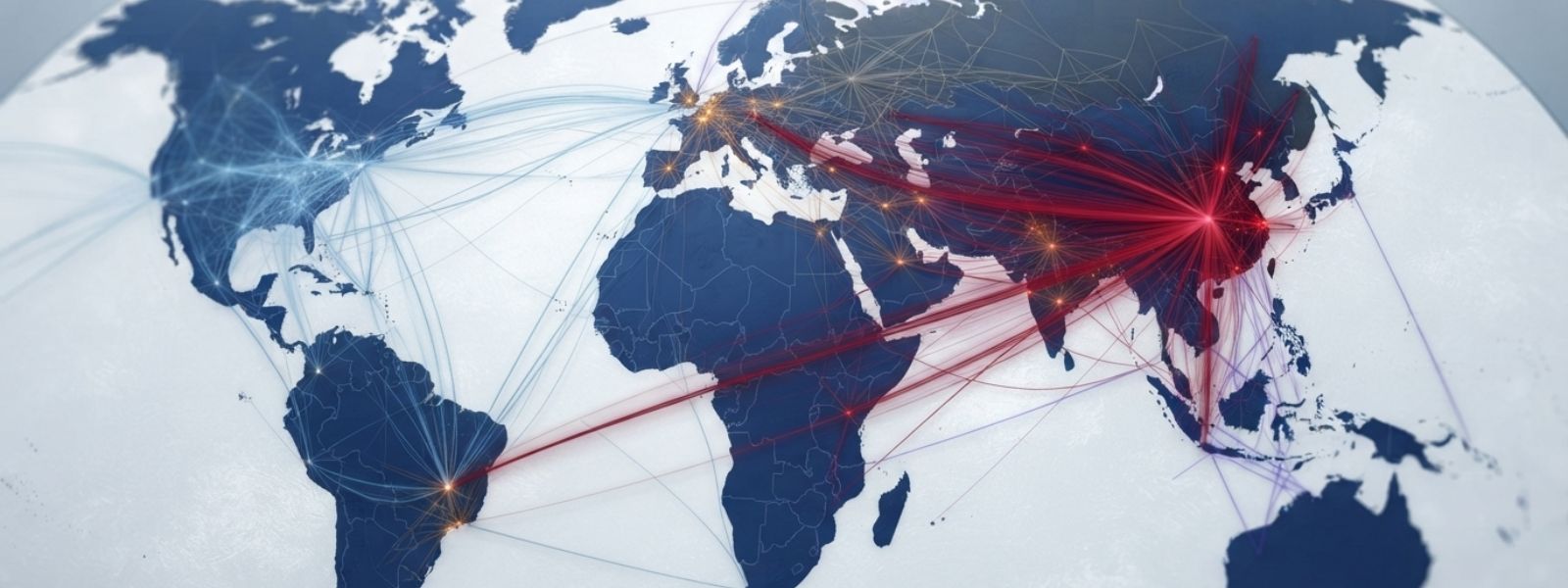
Rise of China, Decline of Unipolarity Reshaping Global Politics



.png )
COLOMBO (News 1st); The post-Cold War international order is rapidly giving way to a new global balance of power shaped by rising geopolitical competition, economic nationalism and growing resistance to traditional great-power dominance, according to internationally renowned international relations scholar Professor T.V. Paul of McGill University, Canada.
Professor Paul, one of the world's leading experts on international security, global power transitions and strategic studies, shared his assessment of evolving global politics while discussing the changing dynamics of American power, the rise of China, the role of Russia and the future of the international order.
The Canadian academic argued that the United States has largely been insulated from the direct suffering experienced by many other regions affected by war and conflict, with the September 11 attacks standing as a notable exception. As a result, he said, there remains insufficient understanding within parts of the American political mainstream about the impact that military interventions can have on other societies.
According to Professor Paul, although some Americans recognize the limitations of past foreign policy approaches, broader changes are needed to embrace coexistence and international cooperation. He maintained that the United States could continue to prosper while pursuing policies that place greater emphasis on stability rather than confrontation.
He also drew parallels with Russia, describing its outlook as being influenced by older concepts of great-power politics. While acknowledging the relatively peaceful emergence of former Soviet republics, he said a continuing challenge for the international system is reconciling the sovereign choices of individual nations with the strategic ambitions of major powers.
Professor Paul identified the 2008 global financial crisis as a significant turning point, arguing that it contributed to a growing perception within the United States that its global status was under pressure. He suggested that concerns over relative decline and the rapid rise of competing powers, particularly China, have played a major role in shaping American strategic behaviour in recent years.
He noted that fears of losing influence, status and privilege are common among major powers throughout history and often influence foreign policy decisions during periods of transition. The emergence of China as a leading economic and technological power, he said, has intensified those concerns.
Discussing US-China relations, Professor Paul described the relationship as a partial rivalry rather than a purely zero-sum competition. However, he pointed out that elements of strategic containment are evident, particularly in critical technology sectors where competition between the two powers continues to intensify.
At the same time, he highlighted the growing importance of middle powers and non-great powers in shaping international relations. Countries such as Canada, Australia and several European nations, he argued, are increasingly questioning traditional assumptions about great-power politics and seeking greater strategic autonomy.
Professor Paul also pointed to what he described as a notable shift in Western responses to recent conflicts compared to the Iraq War era. Unlike the broad coalition that joined the United States during the Iraq conflict, he observed that many Western countries have been more reluctant to participate in contemporary military interventions, reflecting changing attitudes toward the use of force and foreign policy objectives.
He suggested that Western countries would need to maintain greater independence in their foreign policy decision-making and avoid becoming drawn into actions driven primarily by the strategic interests of larger powers, particularly in volatile regions such as the Middle East.
According to Professor Paul, the era of post-Cold War unipolarity has effectively come to an end. He also argued that the so-called liberal international order, which shaped much of the global system following the Cold War, has largely faded as a dominant framework.
However, he emphasized that this does not necessarily represent a rejection of liberal values themselves. Instead, he noted that the international order often benefited some countries more than others and contained significant inequalities that limited its universal appeal.
Professor Paul stressed that the world is now moving toward a new equilibrium characterized by a mixture of competing forces, including economic nationalism, strategic competition, mercantilism and shifting geopolitical alliances. The result, he said, is neither a return to the Cold War nor a continuation of the post-Cold War era, but rather a complex hybrid international system that is still taking shape.
Other Articles


-849947_550x300.jpg)




Featured News


-849213_550x300.jpg)

-848028_550x300.jpg)
News 1st, MTV Channel (Pvt) Ltd, MBC Networks (Pvt) Ltd, 45/3, Braybrooke Street, Colombo-02.
T.P : +94 114 792 700, Fax : +94 114 792 733
T.P : +94 114 792 700, Fax : +94 114 792 733




 |  | .webp) |
|---|---|---|
 |  |  |
 |  |  |
 |
