.webp)


-840789.jpg)
President Moves to Reform Monk Discipline Laws



.png )
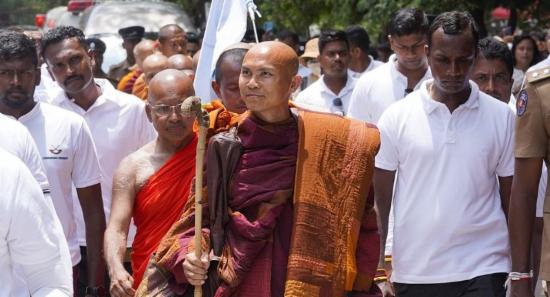
COLOMBO (News 1st); President Anura Kumara Dissanayake has announced plans to amend key provisions of the Vihara Dewalagam Act to strengthen disciplinary oversight within the Buddhist clergy, as part of a broader push to align Sri Lanka’s economic revival with a renewed moral and spiritual foundation.
The President said Sections 41 and 42 of the Act will be revised to empower the Dhamma Tribunal to take necessary disciplinary action against monks, revealing that the legislative process has reached its final stage. “We will expedite the necessary laws as soon as possible,” he said.
Framing the initiative within a wider national vision, Dissanayake stressed that economic progress alone is insufficient without ethical grounding. “Economic prosperity can only be achieved when it is accompanied by a morally grounded society,” he said, adding that both economic and spiritual revival must advance together.
He expressed confidence that the current period would be remembered as a defining era in the country’s religious history.
“It is my expectation, and the expectation of my government, that this era will be remembered as a time of religious awakening in Sri Lanka,” the President said, describing the effort as a comprehensive transformation that goes beyond ritual observance.
Highlighting plans to elevate Sri Lanka’s global Buddhist presence, Dissanayake announced that the country will host the World Buddhist Conference in November. He said the event forms part of a broader strategy to reinforce Buddhism’s central role in shaping the nation’s identity and values. “Buddhism has shaped our society and civilisation; it is impossible to imagine building a Sri Lankan identity without it,” he noted.
The President’s remarks come against a backdrop of growing concern over disciplinary issues within the clergy.
He acknowledged recent incidents that have shaken public confidence, including the arrest of 21 monks in connection with narcotics-related offences, a development he described as deeply troubling.
Speaking candidly, Dissanayake said he had held discussions with representatives of the three Buddhist Nikayas following the arrests, during which a proposal was put forward to first remove the monastic status of accused monks before they are produced in court. “They suggested that those involved should first be derobed before being produced before courts,” he said.
However, the President explained that such a measure could not currently be implemented due to legal constraints. “Legal provisions are based on law, not the Dhamma,” he said, highlighting the gap between religious expectations and existing statutory frameworks as a key reason for pursuing legislative reform.
He emphasised that any misconduct carried out in the name of religion causes profound distress within society. “Any wrongdoing committed in the name of the Dhamma causes us great anguish,” Dissanayake said, pointing to the deep cultural and spiritual ties that bind Sri Lankan communities to their temples and clergy.
Reflecting on traditional values, the President recalled a time when monks commanded deep reverence in everyday life, illustrating the moral standing they once held within villages.
He described how people would kneel in respect when a chief monk passed by, noting that such practices reflected a society shaped by strong spiritual foundations.
“That is why I know, not just for myself, but for all Buddhists in this country, this is a time of deep concern and reflection,” he said, calling for collective introspection and reform to restore integrity within the clergy.
Other Articles

-840777_550x300.jpg)




Featured News
-835300_550x300.jpg)


News 1st, MTV Channel (Pvt) Ltd, MBC Networks (Pvt) Ltd, 45/3, Braybrooke Street, Colombo-02.
T.P : +94 114 792 700, Fax : +94 114 792 733
T.P : +94 114 792 700, Fax : +94 114 792 733




 |  | .webp) |
|---|---|---|
 |  |  |
 |  |  |
 |
