.webp)


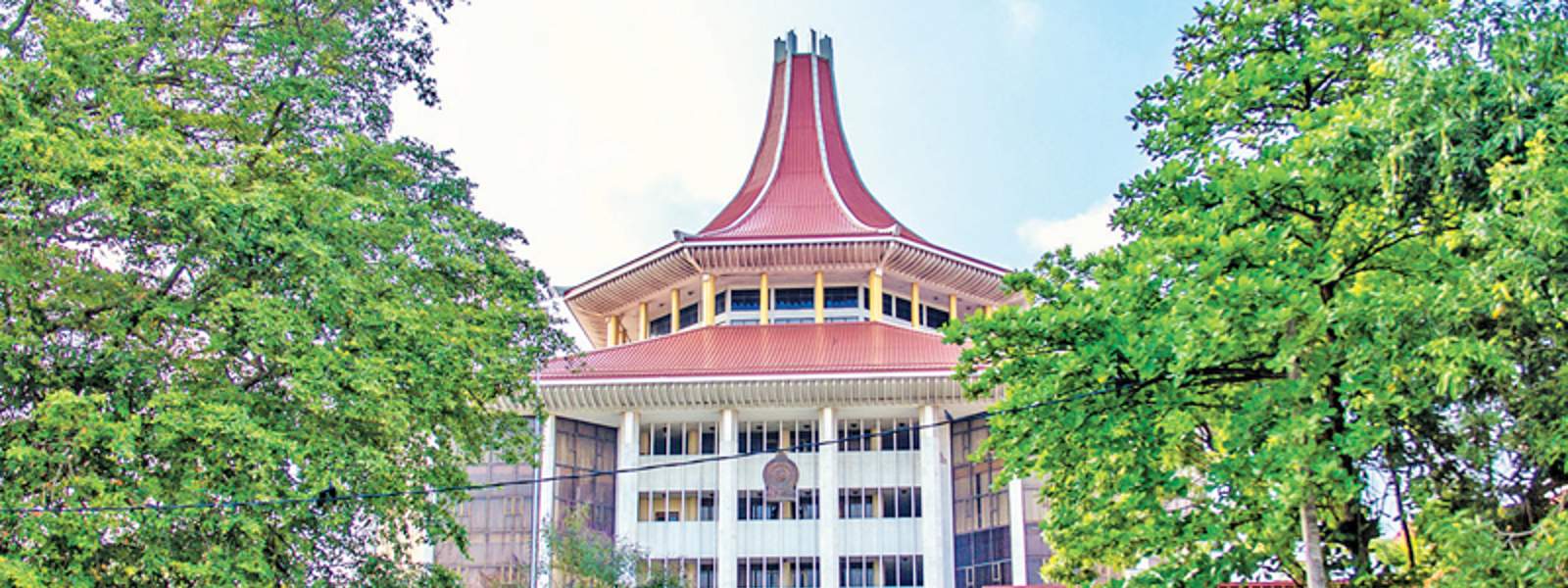
Supreme Court Rejects Full Bench Request; 22A Challenge Continues Before Five-Judge Panel



.png )
COLOMBO (News 1st); The Supreme Court rejected a request made by petitioners seeking to have the challenges against the proposed 22nd Constitutional Amendment heard before a full bench of Supreme Court judges.
The petitions are being heard before a five-member Supreme Court bench comprising Chief Justice Preethi Padman Surasena together with Justices Achala Wengappuli, Arjuna Obeysekera, Sampath Abeykoon and Gihan Kulatunga.
The hearing commenced this morning in Courtroom No. 502 of the Supreme Court.
At the outset, President's Counsel M.A. Sumanthiran and several other lawyers informed the Court that the courtroom lacked sufficient capacity and requested that the proceedings be transferred to a larger courtroom, given the significant public interest surrounding the case.
After considering the submissions, the five-judge bench headed by the Chief Justice directed that the hearing be moved to the more spacious Courtroom No. 501.
Once proceedings resumed, President's Counsel M.A. Sumanthiran and other counsel appearing for the petitioners requested that the challenges to the 22nd Amendment be heard before a bench comprising all sitting Supreme Court judges.
They argued that the proposed amendment would have implications for the entire judiciary and therefore warranted consideration by a full bench of the country's highest court.
Lawyers representing other petitioners also supported the request.
Responding on behalf of the Attorney General, Additional Solicitor General Viraj Dayaratne submitted that the authority and discretion to determine the composition of a judicial bench rests solely with the Chief Justice.
He pointed out that under Article 132(3) of the Constitution, the Chief Justice has the power to determine the number of judges who should hear a particular matter and argued that no other party has the authority to intervene in that process.
President's Counsel Nigel Hatch, appearing for an intervening petitioner, also submitted that there was no legal impediment preventing the Chief Justice from appointing the bench he considered appropriate to hear the case.
After hearing the submissions, the bench adjourned proceedings for 15 minutes.
Upon resumption, Chief Justice Preethi Padman Surasena announced that the petitions would continue to be heard before the originally appointed five-judge bench.
President's Counsel M.A. Sumanthiran then addressed the Court on behalf of the Bar Association of Sri Lanka.
Here's an extract of the submissions made to court by President's Counsel M.A. Sumanthiran:
"Your Lordships, this Bill directly violates Article 3 of the Constitution. Judicial independence is one of the most important components of the sovereignty of the people. However, the proposed Bill undermines the independence of the judiciary and thereby infringes upon the sovereignty of the people. Article 3 is directly linked to Article 4 of the Constitution. Article 3 concerns sovereignty and fundamental rights. Therefore, if any amendment affects matters connected to Article 4, a referendum becomes essential. Before filing this petition, the Bar Association convened a General Meeting. It was unanimously decided that this petition should be filed."
Thereafter, President's Counsel Ali Sabry, appearing on behalf of petitioner and former Minister Professor G.L. Peiris, argued that the proposed Bill would adversely affect judicial independence.
Here's an extract of the submissions made to court by President's Counsel Ali Sabry:
"Your Lordships, this amendment directly conflicts with Article 170 of the Constitution. The balance of power in a democratic state exists between Parliament, the Executive and the Judiciary. If the independence of the judiciary is compromised, that balance of power is directly affected. Based on the Supreme Court determinations relating to the 18th and 19th Constitutional Amendments, any amendment affecting these provisions must necessarily be approved at a referendum in addition to obtaining the required parliamentary majority."
Lawyers representing several other petitioners also made submissions before Court, while the hearing of the petitions continued before the Supreme Court.
Other Articles
-695071-859311_550x300.jpg)



-859287_550x300.jpg)



.png)


Featured News




News 1st, MTV Channel (Pvt) Ltd, MBC Networks (Pvt) Ltd, 45/3, Braybrooke Street, Colombo-02.
T.P : +94 114 792 700, Fax : +94 114 792 733
T.P : +94 114 792 700, Fax : +94 114 792 733




 |  | .webp) |
|---|---|---|
 |  |  |
 |  |  |
 |
