.webp)


Japan Donates Refrigerated Trucks To Ceylon Fisheries Corporation



.png )
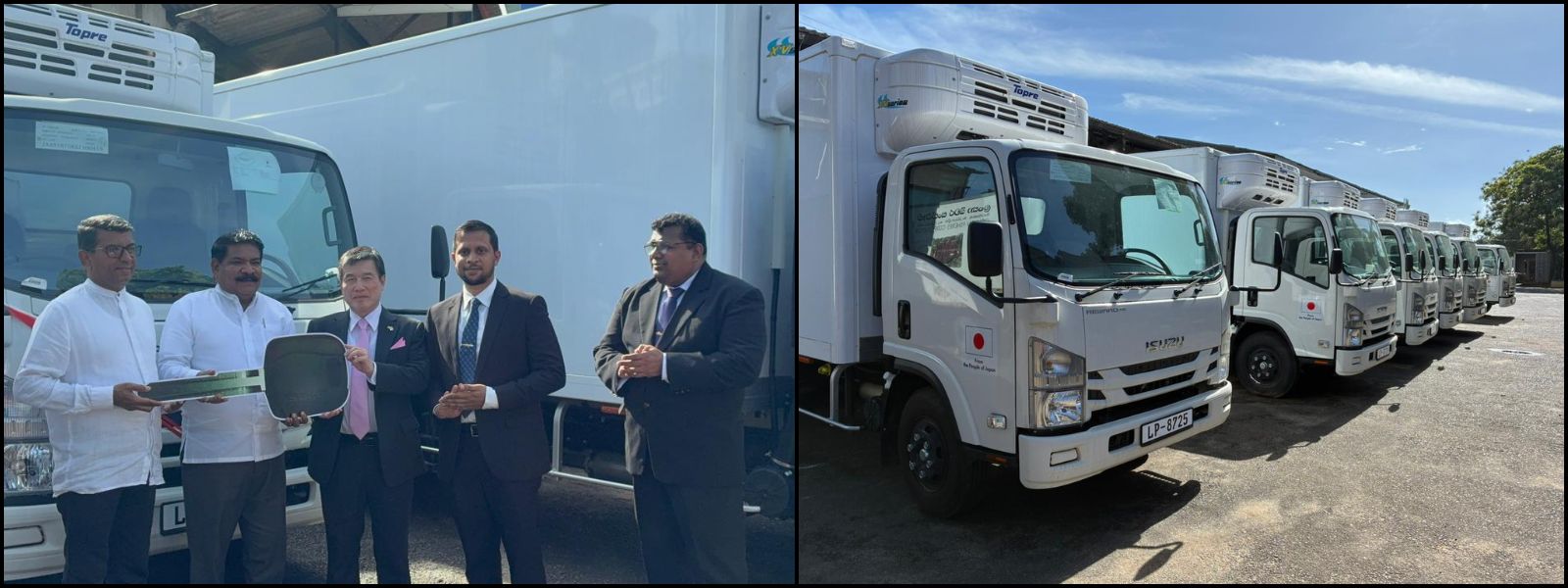
COLOMBO (News 1st); The Government of Japan handed over six state-of-the-art refrigerated trucks to the Ceylon Fisheries Corporation (CFC).
The official handover took place on June 10, with the Ambassador of Japan to Sri Lanka Akio Isomata, presenting the vehicles to CFC Chairman Mohammad Nowras Nasar.
The event was held in the presence of Minister of Fisheries, Aquatic and Ocean Resources Ramalingam Chandrasekar and Deputy Minister Ratna Gamage.
The initiative is part of Japan’s Economic and Social Development Programme, a grant assistance project valued at 200 million Japanese Yen, approximately USD 1.25 million.
In addition to the trucks, the project includes the installation of three ice-making machines in Jaffna, Mullaitivu, and Trincomalee, further enhancing Sri Lanka’s capacity to maintain a robust cold chain for marine products.
Currently, transporting fish from the Northern and Eastern Provinces to Colombo, distances ranging from 300 to 400 kilometres, poses severe logistical challenges. Without adequate temperature control, the country faces significant post-harvest losses, with estimates indicating waste levels as high as 40 percent.
These losses not only reduce the income of fishermen but also impact product quality, food safety, and Sri Lanka’s competitiveness in export markets.
The newly provided refrigerated trucks, which will be operated by the Ceylon Fisheries Corporation, are expected to drastically improve transportation standards, ensuring fish and seafood products remain fresh throughout the supply chain. This development is anticipated to reduce wastage, stabilize prices, and enhance the efficiency of the fisheries distribution network.
Ambassador Isomata emphasized the broader impact of the initiative, stating, “A cold chain is not merely a technology or logistics system for cooling fish; it is the vital foundation that protects the hard work of fishermen, secures the trust of consumers, and supports national food security. Inadequate temperature control not only causes significant post-harvest losses, but also leads to health hazards, price reductions, and loss of market confidence.”
The Ambassador added that amid growing concerns regarding rising food and fuel prices driven by the current situation in the Middle East, strengthening the cold chain and reducing post-harvest losses have become ever more important. “We hope that this assistance will serve as a catalyst for further private sector investment in cold chain infrastructure. The government and people of Japan will continue to stand alongside the people of Sri Lanka as its steadfast friend and partner in support of the country’s journey on the path for sustainable development and resilient society.” The Government of Japan hopes that the equipment will be utilized efficiently and sustainably, contributing to the long-term development of Sri Lanka’s fisheries industry.
Beyond immediate benefits, the project is expected to strengthen national food security, improve incomes for coastal communities, and reinforce Sri Lanka’s seafood export potential.
Other Articles







Featured News



-835300_550x300.jpg)
News 1st, MTV Channel (Pvt) Ltd, MBC Networks (Pvt) Ltd, 45/3, Braybrooke Street, Colombo-02.
T.P : +94 114 792 700, Fax : +94 114 792 733
T.P : +94 114 792 700, Fax : +94 114 792 733




 |  | .webp) |
|---|---|---|
 |  |  |
 |  |  |
 |
