.webp)


$286 a Barrel : Reports Say Sri Lanka Paying A Heavy Price As Global Energy Crisis Escalates



.png )
COLOMBO (News 1st); Sri Lanka has emerged as a stark example of how the global oil crisis is no longer just a matter of volatile prices on trading screens, but a harsh reality felt at the point of physical delivery, according to analysis cited by the Financial Times.
While oil futures have fallen sharply on hopes that the Strait of Hormuz could soon reopen, with August contracts trading below $90 a barrel, the price of securing oil “NOW” has surged dramatically. For refiners and fuel importers who need immediate deliveries, especially in Asia, the gap between paper prices and physical reality has widened to extreme levels.
This divergence is being driven by acute shortages of usable oil in the physical market. Asian buyers, who depend heavily on Gulf supplies, have been forced to pay steep premiums to secure shipments, pushing regional benchmarks such as Oman crude far above widely quoted figures like Brent and West Texas Intermediate.
At its most extreme, the impact has landed in Sri Lanka.
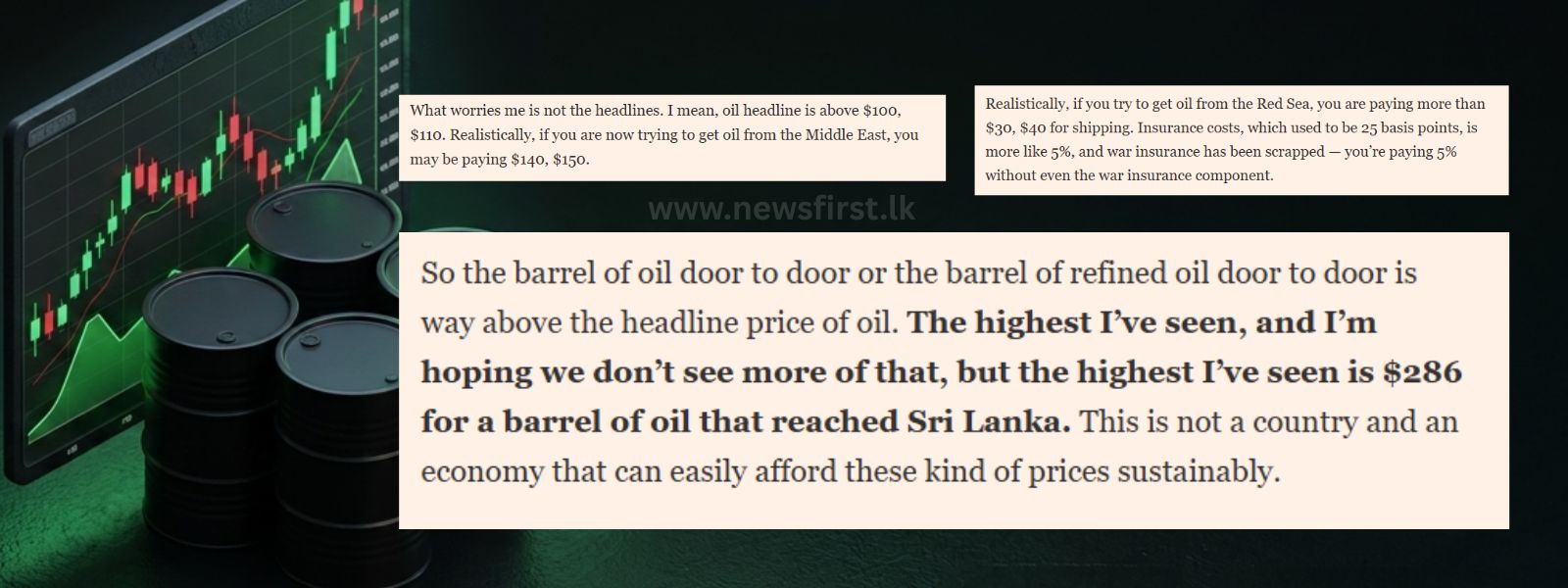
Speaking at HSBC’s Global Investment Summit in Hong Kong on April 14, HSBC Chief Executive Georges Elhedery revealed that the highest “door-to-door” price he had seen for a barrel of oil delivered to the island had reached $286, a figure that includes sharply higher costs for shipping, insurance, and logistical risk.
Elhedery’s full comments published by FT:
"What worries me is not the headlines. I mean, oil headline is above $100, $110. Realistically, if you are now trying to get oil from the Middle East, you may be paying $140, $150.
Realistically, if you try to get oil from the Red Sea, you are paying more than $30, $40 for shipping. Insurance costs, which used to be 25 basis points, is more like 5%, and war insurance has been scrapped, you’re paying 5% without even the war insurance component.
So the barrel of oil door to door or the barrel of refined oil door to door is way above the headline price of oil. The highest I’ve seen, and I’m hoping we don’t see more of that, but the highest I’ve seen is $286 for a barrel of oil that reached Sri Lanka. This is not a country and an economy that can easily afford these kind of prices sustainably"
The result, Elhedery warned, is that the true cost of fuel reaching Sri Lanka bears little resemblance to the headline oil price published daily in global markets.
The figures underline a distressed physical energy market, with pressures particularly severe in Asia, where around 80 percent of oil consumption depends on Gulf supplies, according to analysts at JPMorgan.
In a recent note, the bank said that with roughly 13 million barrels a day missing from global supply, European and Asian refiners are competing aggressively for remaining cargoes.
This scramble has driven dated Brent, a benchmark tied more closely to immediate physical delivery, to record highs, reaching $144 a barrel on April 7, surpassing levels seen on the eve of the 2008 financial crisis. At the same time, Brent futures for June delivery were trading at around $109, highlighting an unusually large gap between physical and paper markets.
Historically, that difference has been limited to around $1 to $2 a barrel, reflecting smooth arbitrage between futures and physical supply.
Today’s far wider spread is a signal that oil available for immediate delivery is scarce, even as traders bet that supply conditions may ease in the future.
Source: Financial Times
Other Articles

-835312_550x300.jpg)
-835300_550x300.jpg)


-835241_850x460-835275_550x300.jpg)


Featured News



News 1st, MTV Channel (Pvt) Ltd, MBC Networks (Pvt) Ltd, 45/3, Braybrooke Street, Colombo-02.
T.P : +94 114 792 700, Fax : +94 114 792 733
T.P : +94 114 792 700, Fax : +94 114 792 733




 |  | .webp) |
|---|---|---|
 |  |  |
 |  |  |
 |
