.webp)


Sri Lanka Rupee Slips as Middle East Conflict Triggers Regional Currency Pressures



.png )
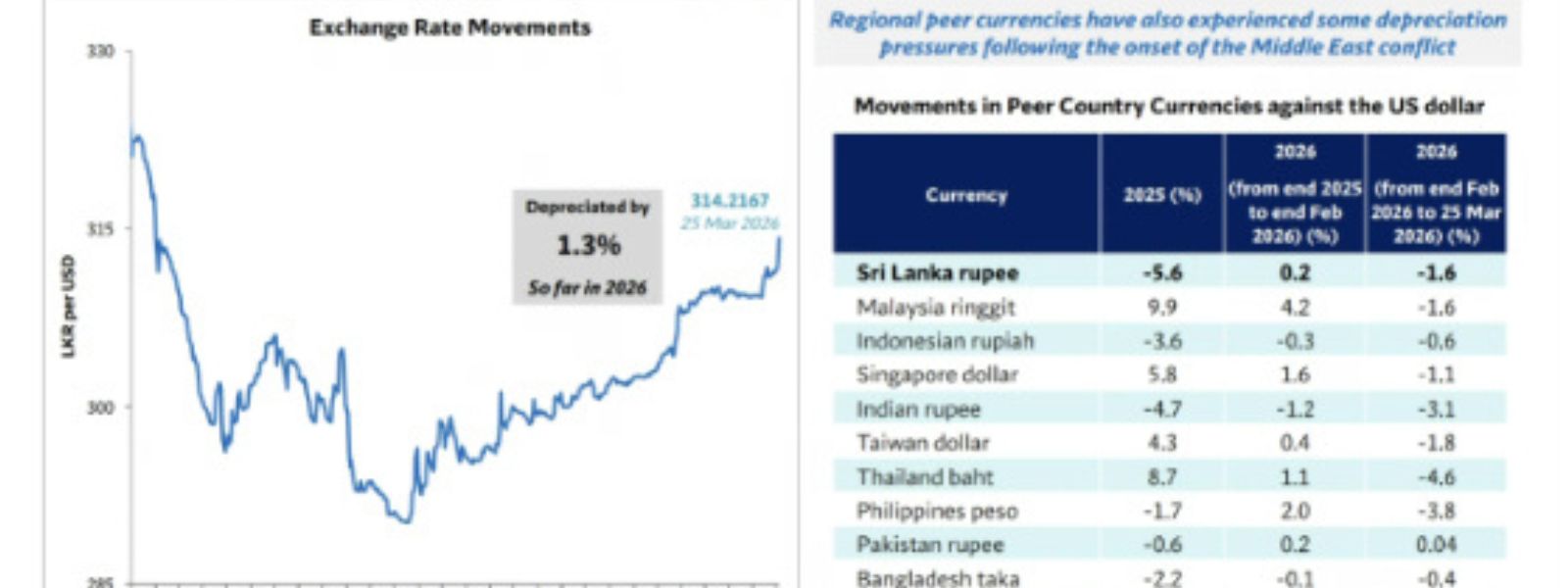
COLOMBO (News 1st); The Sri Lanka rupee, which remained relatively stable in the early months of 2026, has come under moderate depreciation pressure following the onset of the Middle East conflict, according to data presented in the Central Bank of Sri Lanka’s Monetary Policy Review for March 2026.
Central bank figures show that the rupee has depreciated by around 1.3 percent so far in 2026, with the exchange rate reaching approximately Rs. 314.2 against the US dollar by 25 March 2026.
This movement follows a period of relative stability at the start of the year, before global developments began to influence foreign exchange markets.
The data indicates that depreciation pressures intensified after the escalation of the Middle East conflict, reflecting broader regional and global trends. A comparative analysis of regional currencies against the US dollar suggests that Sri Lanka was not alone in experiencing currency weakness during this period.
According to the peer-country comparison, the Sri Lanka rupee recorded a 5.6 percent depreciation in 2025. In early 2026, the rupee showed a 0.2 percent appreciation during the period from end-February to end-March, but still registered a 1.6 percent depreciation from the end of 2025 to 25 March 2026.
Other regional currencies also faced similar pressures. The Malaysian ringgit showed a depreciation of 9.9 percent in 2025 and 1.6 percent so far in 2026. The Indonesian rupiah declined 3.6 percent in 2025 and 0.6 percent in 2026, while the Indian rupee weakened 4.7 percent in 2025 and 3.1 percent in the current year to date. The Thai baht, Philippine peso, Pakistan rupee, Bangladesh taka, Vietnamese dong, and Nepalese rupee also recorded varying degrees of depreciation, underscoring the region-wide impact of global uncertainties.
The Central Bank’s analysis highlights that the renewed pressures on the rupee largely coincided with heightened geopolitical tensions. Despite these challenges, the overall movement of the rupee in early 2026 has been moderate when compared with some regional peers.
Other Articles

-860489_550x300.jpg)

-860477_550x300.jpg)
-860471_550x300.jpg)

Featured News




News 1st, MTV Channel (Pvt) Ltd, MBC Networks (Pvt) Ltd, 45/3, Braybrooke Street, Colombo-02.
T.P : +94 114 792 700, Fax : +94 114 792 733
T.P : +94 114 792 700, Fax : +94 114 792 733




 |  | .webp) |
|---|---|---|
 |  |  |
 |  |  |
 |
