


The Night Ditwah Struck: One Year Later, How Far Has Sri Lanka Recovered?



.png )
COLOMBO (News 1st); One year ago today, Sri Lanka woke up to a nightmare that would become the country's most devastating natural disaster since the 2004 Indian Ocean tsunami.
Cyclone Ditwah, which intensified rapidly from a deep depression over the seas off Hambantota and Pottuvil on the night of November 26, swept into the country in the early hours of November 27, unleashing destruction on a scale few had imagined. Within hours, communities from coast to hill country found themselves battling deadly floods, landslides, powerful winds and widespread devastation.
The human cost was heartbreaking. More than 650 people lost their lives. Over 2.2 million people were affected. Families were torn apart, homes disappeared beneath mud and floodwaters, and entire villages saw years of hard-earned progress vanish overnight.
According to World Bank estimates, the disaster inflicted economic losses exceeding US$4 billion, making it one of the costliest catastrophes in Sri Lanka's history. More than 55,000 houses were either completely destroyed or severely damaged, while vital infrastructure suffered unprecedented setbacks.
Among the worst-hit sectors was transportation. The iconic upcountry railway line, celebrated globally for its breathtaking journeys through Sri Lanka's central highlands, sustained extensive damage. Infrastructure losses alone exceeded US$1.7 billion, while the agriculture sector recorded damages surpassing US$800 million, leaving farmers struggling to recover from shattered harvests and ruined livelihoods.
While lost lives can never be replaced, the focus over the past year has been on helping survivors rebuild.
Faced with an emergency that crippled roads, communications and access to many remote areas, the Government, armed forces, police and disaster management authorities launched one of the largest rescue and relief operations in recent memory. An additional Rs. 500 billion was allocated to address immediate needs and support long-term recovery efforts.
Twelve months later, the numbers reveal substantial progress, although the rebuilding journey is far from complete.
Authorities state that nearly 99 percent of the Rs. 25,000 and Rs. 50,000 relief allowances promised to affected families have been disbursed. Assistance earmarked for families left without habitable homes has also reached almost all intended beneficiaries.
The monthly Rs. 25,000 rental allowance granted to families awaiting permanent housing has been paid to nearly 94 percent of recipients. Meanwhile, almost every affected schoolchild has received the Rs. 15,000 allowance introduced to replace lost educational materials and essentials.
Housing reconstruction remains one of the most challenging aspects of the recovery effort. Officials identified 29,983 families requiring resettlement. More than Rs. 2.7 billion has already been spent on housing assistance, with full payments completed for 9,931 homes. To date, 1,615 families have been permanently resettled, while compensation payments have been issued for 63 percent of the country's 100,771 partially damaged houses.
Signs of recovery are also visible along the damaged railway network. Train services have gradually resumed on several sections that had been left crippled after the disaster. Services now operate up to Peradeniya, while reconstruction work continues on affected stretches between Peradeniya, Kandy and Gampola. Locomotives and rolling stock stranded by the catastrophe have also been returned to service where possible.
Yet recovery is not simply about rebuilding what was lost.
Engineers and planners are attempting to ensure that roads, railways and public infrastructure can withstand future disasters. Construction in unstable and high-risk zones remains restricted, with institutions such as the National Building Research Organisation continuing to conduct assessments before major rebuilding projects proceed.
For many survivors, however, recovery is measured in more personal terms. It is the return of electricity after weeks in darkness. The reopening of a road that reconnects a village to the outside world. The first train whistle heard once again in the hill country. The keys to a new home after months of uncertainty.
A year after Cyclone Ditwah brought unimaginable loss and devastation, Sri Lanka's recovery is still a work in progress. Yet across the country, the signs of renewal are impossible to ignore. Homes are rising where rubble once lay, children have returned to classrooms, trains are slowly reconnecting communities, and families who feared they had lost everything are rebuilding their futures piece by piece.
The storm tested the nation's strength. The recovery has revealed its resilience. While the scars of Ditwah will remain for generations, so too will the determination of the people who refused to let the disaster define their future.
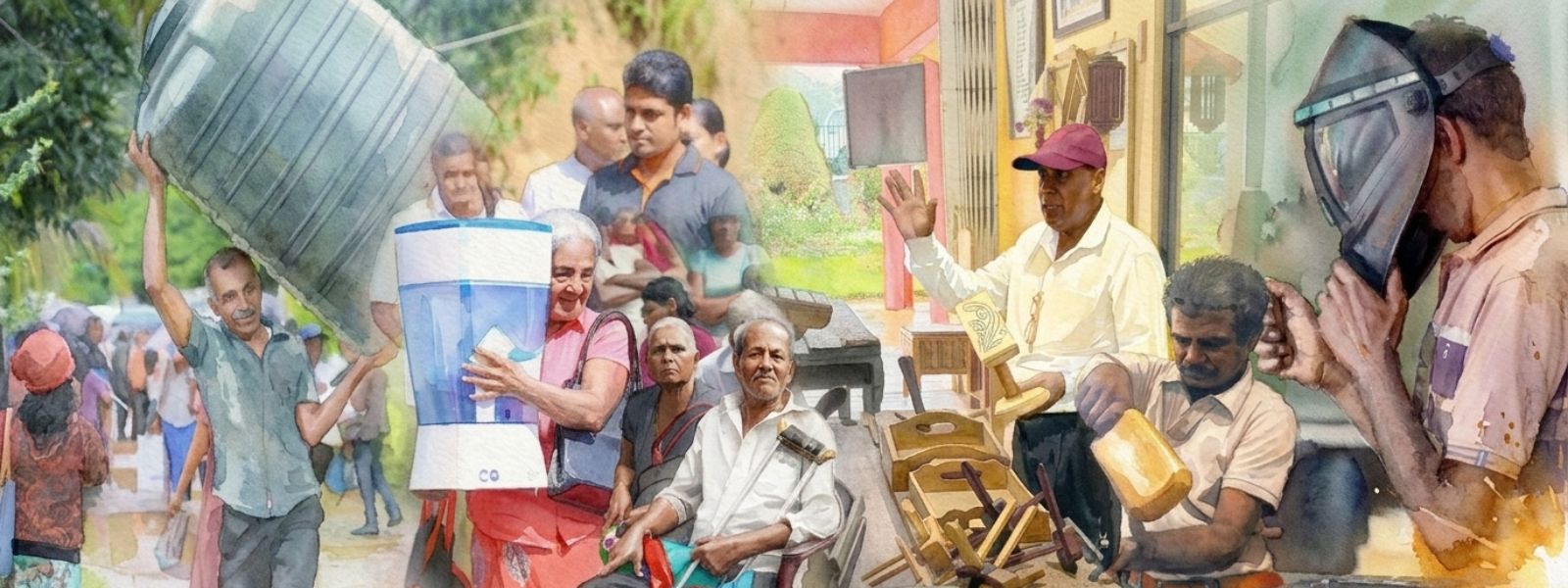
When Cyclone Ditwah tore through parts of Sri Lanka, the response from Gammadda did not end with emergency relief. What began as an urgent rescue mission evolved into a long-term effort to help affected families rebuild their lives, livelihoods and communities through a structured five-stage disaster response programme encompassing Rescue, Relief, Recover, Rebuild and Resilience.
As the cyclone struck, Gammadda's volunteer teams were mobilised immediately, launching emergency rescue operations in some of the worst-hit areas. At the same time, the Sirasa Shakthi Sahana Yathra relief initiative began delivering critical assistance to affected communities, ensuring that families received essential support during the most difficult hours following the disaster.
With the backing of people from across the country, Gammadda spent an entire month collecting dry rations and essential supplies before distributing them among affected families nationwide. The effort received considerable support from state institutions, including the Tri-Forces, Police and other government officials who assisted with relief operations on the ground.
In locations cut off by damaged infrastructure and impassable roads, the Sri Lanka Air Force and even United States military aircraft joined the humanitarian effort, helping transport urgently needed supplies. Specially packed food and essential goods were also air-dropped into isolated areas that could not be reached by conventional means.
Once the immediate rescue and relief phase had been completed, Gammadda shifted its focus toward restoring normalcy through its "Care and Dare" camps. These programmes were launched in the severely affected districts of Kandy, Matale, Nuwara Eliya and Badulla, providing continued support to families struggling to recover from the disaster.
Beyond distributing dry rations, the camps offered a wide range of services designed to help people rebuild their lives. Medical clinics, legal assistance, self-employment support, vocational guidance and help with replacing lost documents were among the key services made available to affected communities.
The next phase focused on rebuilding livelihoods. Through the Gammadda Rebuild initiative, individuals engaged in tailoring, carpentry, masonry, electrical work, welding and plumbing were provided with the tools required to restart their trades. Training opportunities and certification programmes were also conducted to help recipients regain economic stability and move forward with confidence.
Agriculture, one of the sectors hardest hit by the cyclone, received special attention. Working closely with the Department of Agrarian Development, Gammadda supported efforts to rehabilitate damaged minor irrigation systems and farmlands across Kandy, Matale, Nuwara Eliya and Badulla, helping farming communities return to cultivation.
Even as recovery efforts continued, preparations for future emergencies were already underway. Gammadda invested in life-saving equipment, including rescue boats and life jackets, which have now been positioned with the Sri Lanka Life Saving Association for rapid deployment whenever disasters occur.
Alongside this, volunteer groups are being trained in partnership with the Sri Lanka Life Saving Association, creating community-based emergency response networks capable of assisting rescue operations when future disasters strike.
For Gammadda, the response to Cyclone Ditwah was never limited to delivering aid. It became a mission that followed communities every step of the way, from rescue and relief to recovery, rebuilding and long-term resilience, proving once again that meaningful change happens when people stand together for people.
Other Articles




Featured News




News 1st, MTV Channel (Pvt) Ltd, MBC Networks (Pvt) Ltd, 45/3, Braybrooke Street, Colombo-02.
T.P : +94 114 792 700, Fax : +94 114 792 733
T.P : +94 114 792 700, Fax : +94 114 792 733




 |  |  |
|---|---|---|
 |  |  |
 |  |  |
 |
