.webp)


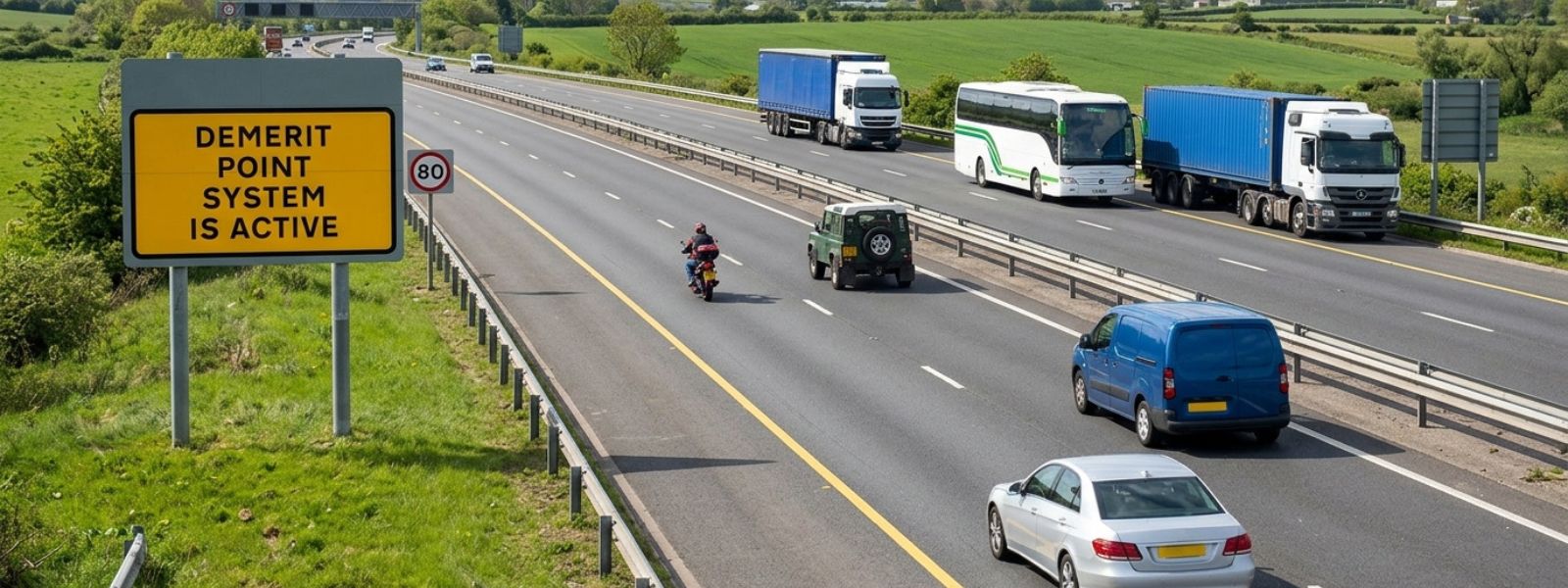
Too Many Crashes, Too Many Funerals: Sri Lanka Launches Demerit Points Pilot Project



.png )
COLOMBO (News 1st); For years, Sri Lankan roads have operated on a familiar formula.
Break a traffic rule. Pay a fine. Move on.
But officials now believe that formula has failed to change the behaviour of a small but dangerous group of repeat offenders who continue to rack up violations, putting lives at risk every day.
That is why, starting this October, Sri Lanka will begin testing a new Demerit Points System, a pilot programme that could fundamentally change how traffic offences are monitored and punished across the country.
Announcing the initiative, Transport Minister Bimal Rathnayake said the six-month pilot programme will run until March 31 next year, giving both authorities and motorists time to adapt to what will become a fully digital traffic enforcement system.
The concept is simple.
Every licensed driver will receive a fixed allocation of points. Those points act almost like a driving reputation score. Every time a traffic offence is committed, points are deducted. The more serious the offence and the more often it is repeated, the faster the points disappear.
And once that score reaches zero, authorities will have the power to temporarily suspend a driver's licence.
The move comes as Sri Lanka continues to battle a troubling road safety crisis.
So far this year, the country has recorded 1,897 fatal road accidents, claiming 2,002 lives.
The statistics are more than just numbers.
According to Minister Rathnayake, the demerit system is not an experiment. Variations of it have already been used in more than 30 countries, where authorities have reported measurable reductions in road accidents and fatalities.
He said studies from countries that use the system indicate that within 12 to 18 months, accident and death rates have generally fallen by 15 to 20 percent, while major road crashes have also declined.
Importantly, officials insist the system is not designed to punish drivers for an occasional mistake.
A driver who receives a minor traffic ticket every now and then is unlikely to face serious consequences.
Instead, the programme is designed to identify motorists who repeatedly ignore road rules, accumulate violations, and continue driving recklessly regardless of how many fines they receive.
The philosophy behind the reform is straightforward: a fine may hurt a driver's wallet, but the threat of losing driving privileges changes behaviour.
What makes the new system particularly significant is its digital backbone.
The Ministry plans to integrate the demerit programme with the online traffic fine payment platforms already in operation. Every offence, payment, and points deduction will be recorded electronically.
Officials say that level of automation is intended to reduce opportunities for interference, manipulation, or unauthorized alterations.
Adding further details, Digital Economy Ministry Advisor Sumudu Rathnayake explained that motorists will be able to see exactly how many points have been deducted after paying a traffic fine.
Each of the 33 traffic offences included under the programme will be linked to a specific demerit value.
After paying a fine, drivers will receive a receipt indicating the number of points deducted. They will also receive an SMS notification showing the same information.
The pilot phase is expected to serve another purpose as well.
Authorities want drivers to become familiar with the system before it becomes fully operational. During these six months, motorists will be able to understand how different offences affect their score and how repeated violations can eventually place their driving privileges at risk.
For policymakers, the goal goes beyond technology.
The larger objective is cultural.
For decades, Sri Lanka's road safety challenge has not simply been about traffic laws. It has been about behaviour, habits, and accountability.
The hope is that by introducing a system that tracks patterns rather than isolated incidents, dangerous drivers can be identified before they become part of another tragic road accident statistic.
Whether the demerit system succeeds will become clearer in the months ahead.
But with more than two thousand lives already lost on Sri Lankan roads this year, authorities appear convinced that doing nothing is no longer an option.
Other Articles


-856887_550x300.jpg)

-856870_550x300.jpg)


.png)


Featured News




News 1st, MTV Channel (Pvt) Ltd, MBC Networks (Pvt) Ltd, 45/3, Braybrooke Street, Colombo-02.
T.P : +94 114 792 700, Fax : +94 114 792 733
T.P : +94 114 792 700, Fax : +94 114 792 733




 |  | .webp) |
|---|---|---|
 |  |  |
 |  |  |
 |
