.webp)


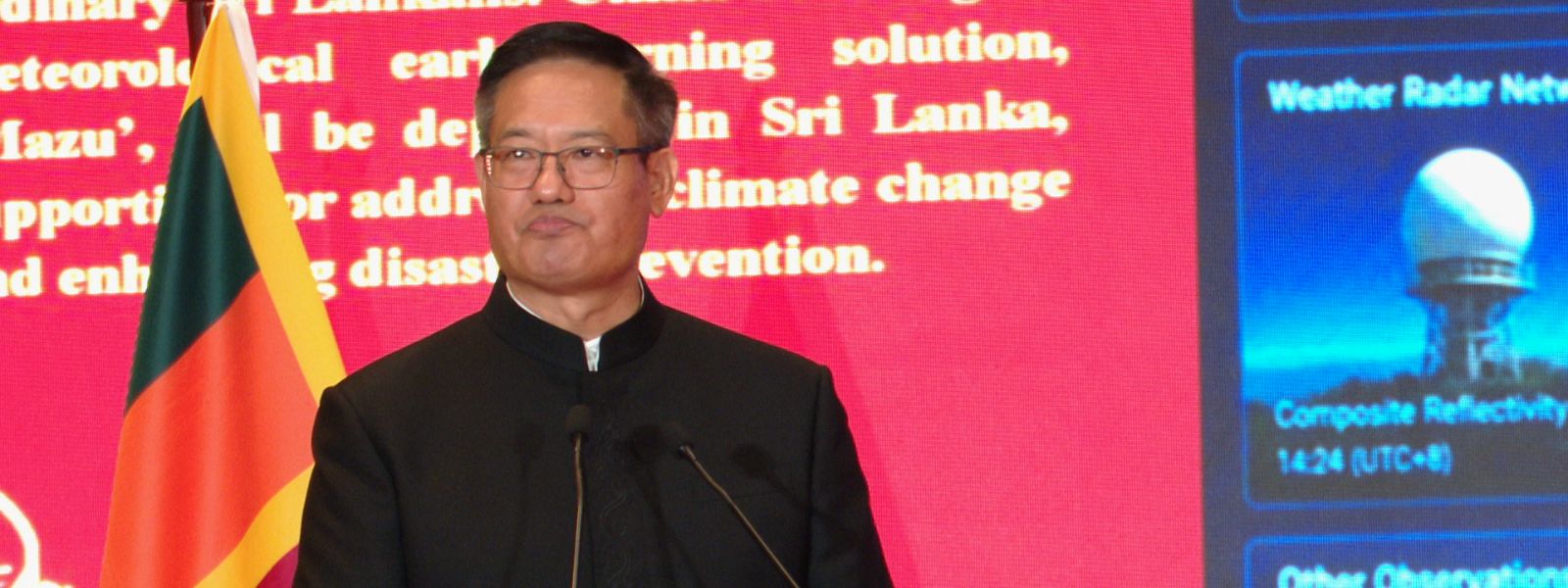
‘No Matter What Happens’: China Says Sri Lanka Will Never Stand Alone



.png )
COLOMBO (News 1st); As great-power competition increasingly shapes the geopolitical landscape of Asia, China's new Ambassador to Sri Lanka, Wei Huaxiang, used the 77th anniversary of the founding of the People's Republic of China to deliver a clear message: Beijing sees Sri Lanka not merely as a partner, but as a trusted friend and a key player in its vision for regional cooperation, development and a more multipolar world.
Addressing diplomats, political leaders and guests in Colombo, Ambassador Wei framed China-Sri Lanka relations within a broader global narrative, linking the island nation's future to China's own transformation from a war-ravaged and impoverished country into the world's second-largest economy.
"This year marks the 77th anniversary of the founding of the People's Republic of China and the 105th anniversary of the Communist Party of China," he said, noting that China had undergone profound changes through what he described as determination, perseverance and modernization. According to the Ambassador, China is now pursuing national rejuvenation while simultaneously creating new opportunities for the rest of the world through its own development.
Placing Sri Lanka prominently within that vision, Wei highlighted the evolution of bilateral cooperation from historical maritime links to modern infrastructure and investment partnerships. Referencing China's Belt and Road Initiative, he said flagship projects such as the Colombo Port City and Hambantota Port stand as symbols of the depth and scale of China-Sri Lanka cooperation.
The Ambassador said China remains committed to what he described as seeking shared interests with the world and pointed to growing economic engagement that has connected the two countries in trade, infrastructure and investment. He noted that Chinese enterprises operating in Sri Lanka had continued to expand cooperation despite global challenges, contributing to development across multiple sectors.
Beyond economics, Wei devoted significant attention to governance, arguing that China's system of "Whole-Process People's Democracy" allows public voices to reach the highest levels of decision-making. He noted that legislative exchanges between China and Sri Lanka continue to expand, strengthening cooperation and mutual learning between the two countries.
Culture also featured prominently in his address. From ancient exchanges between Buddhist monks to modern cultural diplomacy, Wei described people-to-people engagement as one of the strongest pillars of the bilateral relationship. He recalled the journeys of Faxian and Tissara as enduring symbols of the historical bonds between the two civilizations.
The Ambassador highlighted the growing popularity of Chinese culture worldwide, pointing to iconic figures such as Wukong and Nezha, the global surge in tourism to China, and the activities of the China Cultural Centre and Confucius Institutes in Sri Lanka. Events such as the "Happy Chinese New Year" celebrations, the "Chinese Bridge" competition, the "Tea for Harmony" initiative and the Dragon Boat Culture Festival were cited as examples of expanding cultural engagement between the two nations.
Wei also sought to underline the practical benefits of the partnership. He said the China-Sri Lanka Joint Research and Demonstration Centre for Water Technology is helping provide access to safe drinking water for Sri Lankan communities, while China's school uniform assistance programme has benefited more than 4.4 million students across the country over the past four years.
In the area of technology and sustainability, the Ambassador emphasized China's leadership in renewable energy, noting that the country now possesses the world's largest renewable energy system. He highlighted advances in solar, wind and energy-storage technologies and pointed to the growing presence of Chinese electric vehicle brands in Sri Lanka. He also announced that China's intelligent weather early-warning platform, "Mazu," will be deployed in Sri Lanka to assist with disaster preparedness and climate adaptation efforts.
Positioning Beijing as a defender of multilateralism at a time of increasing geopolitical competition, Wei referenced Chinese President Xi Jinping's vision of building a "community with a shared future for humanity." He also highlighted China's Global Development Initiative, Global Security Initiative, Global Civilization Initiative and Global Governance Initiative as responses to contemporary international challenges.
Sri Lanka's own diplomatic traditions featured prominently in the speech. The Ambassador described Sri Lanka as an important founding member of the Non-Aligned Movement and praised the country's role in the 1976 Non-Aligned Summit, which he described as a landmark moment in Sri Lankan diplomacy. He said China is prepared to work closely with Sri Lanka in promoting multilateralism and defending international fairness and justice.
Wei repeatedly returned to the historic significance of the 1952 Rubber-Rice Pact, describing it as a defining example of solidarity between the two countries during difficult times. According to him, the spirit of the agreement continues to guide bilateral relations today, enabling both countries to support one another while resisting external pressures.
The Ambassador also recalled recent examples of mutual assistance, including Sri Lanka's support during the search for the Chinese fishing vessel Lupeng Yuanyu 028, emergency assistance provided to a Chinese researcher aboard the vessel Shiyan 6, and China's support for Sri Lanka during the COVID-19 pandemic and in the aftermath of Cyclone Ditwah.
Looking ahead, Wei noted that 2027 will mark two significant milestones: the 70th anniversary of diplomatic relations between China and Sri Lanka and the 75th anniversary of the Rubber-Rice Pact. He said both countries must build on their shared history while adapting to new realities, deepen strategic cooperation, strengthen mutual trust and continue advancing what he described as a partnership based on sincere mutual assistance and enduring friendship.
In an era of shifting alliances, intensifying geopolitical rivalries and growing economic uncertainty, Wei's message from Colombo was unmistakable: China sees Sri Lanka as an enduring strategic partner, and Beijing intends for that partnership to play an even larger role.
Other Articles





.png)


Featured News




News 1st, MTV Channel (Pvt) Ltd, MBC Networks (Pvt) Ltd, 45/3, Braybrooke Street, Colombo-02.
T.P : +94 114 792 700, Fax : +94 114 792 733
T.P : +94 114 792 700, Fax : +94 114 792 733




 |  | .webp) |
|---|---|---|
 |  |  |
 |  |  |
 |
