.webp)


When the Rain Stops: Villages, Livestock and Wildlife Fight for Survival



.png )
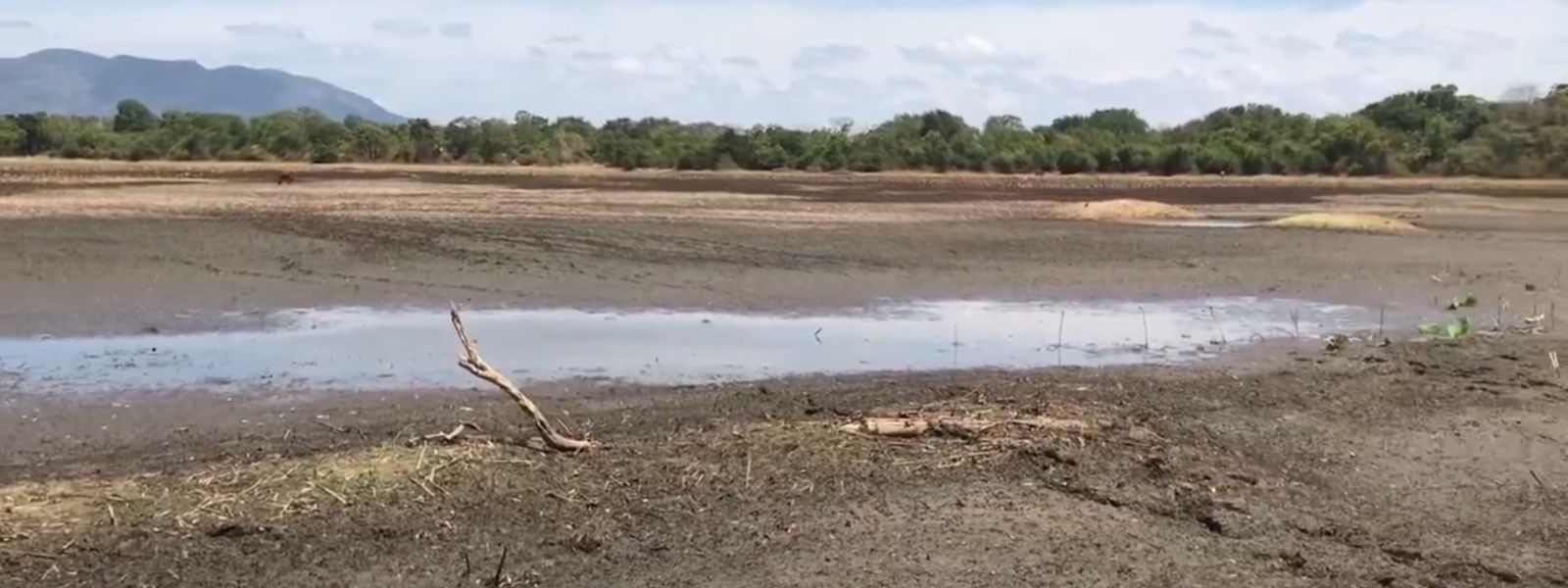
COLOMBO (News 1st): The wewas (irrigation tanks) have disappeared. The paddy fields have turned brown. The cattle wander in search of water. And in some villages, residents say even finding enough to prepare a simple meal has become a daily struggle.
Across Sri Lanka's dry zone, the prolonged dry weather is leaving behind a trail of devastation, damaging more than 8,000 acres of paddy cultivation in the districts of Monaragala, Polonnaruwa, Hambantota, Anuradhapura and Ampara. Of those districts, Monaragala has suffered the greatest impact.
While crops continue to wither, wildlife is facing an equally desperate battle for survival as water scarcity grips vast areas of the country.
Nowhere is the crisis more visible than in the Kantale and Thambalagamuwa areas of Trincomalee, where reservoirs that once held water throughout the year have almost completely dried up.
Peramadu Wewa, Nika Wewa, Samagi Wewa and 91 Wewa, once lifelines for surrounding villages, now lie barren under the scorching sun.
Only a small amount of water remains in two reservoirs.
Villagers have taken the unusual step of preserving the remaining water not for themselves, but for wildlife.
"We are carefully protecting the little water left in Nika Wewa without disturbing it, so that animals can drink from it," one resident said.
For farmers, however, there is little left to save.
Paddy fields have dried out completely, forcing many cultivators to abandon their harvests.
In some areas, farmers have opened up their fields and allowed cattle to graze on crops that were never harvested.
"The entire crop has failed. We did not receive enough irrigation water, and there was no rainfall either. Look over there, the cattle are now feeding on what remains of the paddy," a farmer said.
Months of battling an unforgiving sky and cracked earth have left farming communities exhausted.
In the village of Ulpathwewa, residents say the drought has shattered livelihoods and daily life.
"Ulpathwewa is a very old village with more than 56 families. Today, there isn't enough water even for a cow to drink. After Kantale Wewa dried up, we don't even have water for ourselves. We are living a very difficult life. Nearly 80 percent of our paddy cultivation has been destroyed. Elephants are breaking through fences and entering the village. When you look inside homes today, some families don't even have enough to prepare a simple meal," a resident said.
The impact is also being felt by livestock farmers.
"We used to collect around 20 litres of milk a day. Now we get only five litres. The cattle have neither water nor food," another villager explained.
Beyond agriculture, the freshwater fishing industry has also slowed dramatically, depriving many families of an important source of income.
Residents say making ends meet has become increasingly difficult.
As reservoirs continue to dry up, wildlife is being forced closer to human settlements. Villagers report that herds of elephants and other animals are now regularly entering communities in search of water, creating additional challenges for already struggling residents.
In response to the growing crisis, the Government has taken steps to provide drinking water to 37,890 people in the Monaragala District and 28,523 people in the Batticaloa District.
Meanwhile, Chairman of the Agricultural and Agrarian Insurance Board Premasiri Jasinghearachchi announced that compensation payments for drought-damaged farmland will begin next Friday.
Farmers will receive Rs. 100,000 per hectare, with the Government allocating Rs. 3 billion for the programme.
The compensation will cover drought-related losses in paddy, maize, big onion and potato cultivation.
But for many families staring at dried-up fields, the relief cannot come soon enough.
Until the rains return, thousands of farmers, their livestock and the wildlife that share the same shrinking resources remain locked in a struggle against one of the harshest dry spells in recent years.
Other Articles


-859908_550x300.jpg)
-859896_550x300.jpg)


Featured News




News 1st, MTV Channel (Pvt) Ltd, MBC Networks (Pvt) Ltd, 45/3, Braybrooke Street, Colombo-02.
T.P : +94 114 792 700, Fax : +94 114 792 733
T.P : +94 114 792 700, Fax : +94 114 792 733




 |  | .webp) |
|---|---|---|
 |  |  |
 |  |  |
 |
