.webp)


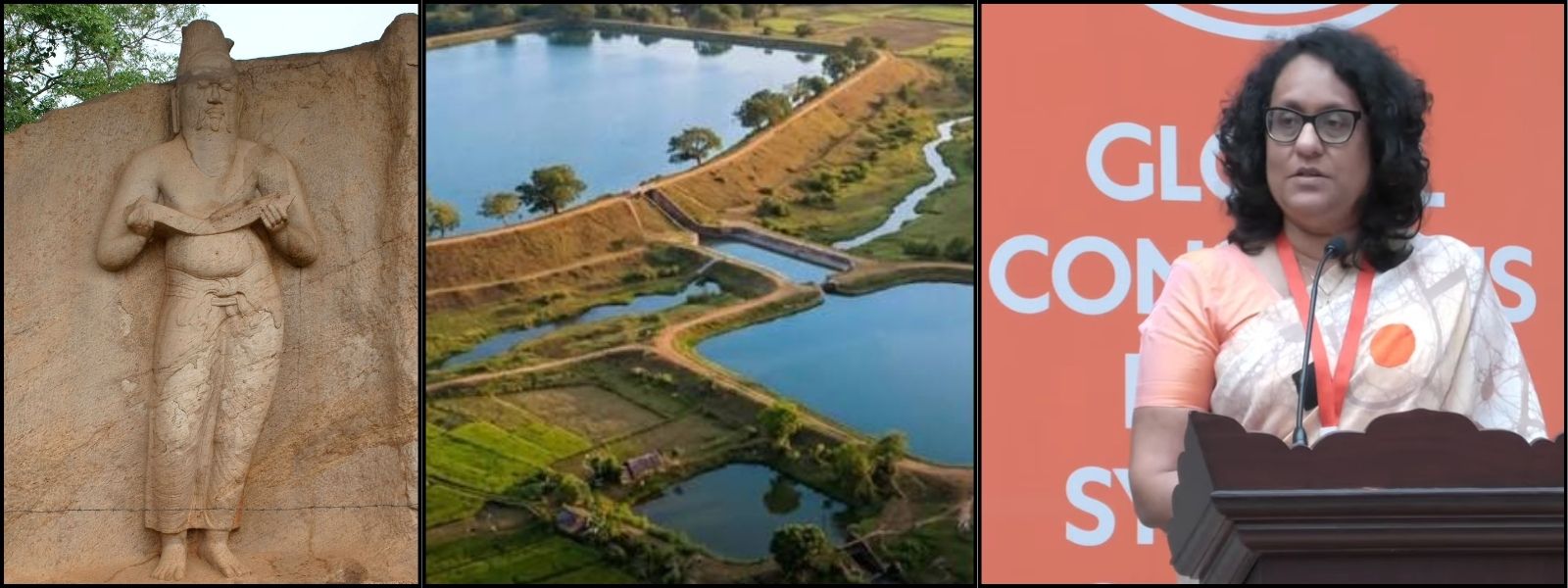
What King Parakramabahu Can Teach the Modern World : PM Explains In Bhutan



.png )
COLOMBO (News 1st): The answer to today's food crisis does not lie in turning the clock back, but neither does it lie in forgetting the lessons of the past.
That was the message delivered by Prime Minister Dr. Harini Amarasuriya as she addressed the Global Conscious Food Systems Summit 2026 in Bhutan, where she urged the international community to draw on traditional wisdom while embracing modern solutions to build more sustainable and resilient food systems.
Speaking at the summit, the Prime Minister said Sri Lanka possesses a rich heritage of food-related knowledge and practices that enabled communities to achieve food security while maintaining a close relationship with nature and the environment.
Dr. Amarasuriya highlighted Sri Lanka's ancient Wewa-Gama or tank-village cascade system as one of the most remarkable examples of sustainable resource management in human history.
Developed and refined over nearly 2,000 years, the interconnected network of reservoirs (wewas or tanks) across Sri Lanka's dry zone was designed not merely to store water, but to sustain entire ecosystems and communities.
She explained that the system supported agriculture, home gardens, forests, livestock and rural livelihoods while reflecting a broader understanding that human prosperity depended on the health of the natural environment.
According to the Prime Minister, Sri Lanka's ancient rulers understood the importance of safeguarding resources for future generations.
She referred to the famous principle attributed to King Parakramabahu the Great, who declared that not even a single drop of water should be allowed to flow into the sea without first being put to productive use.
Dr. Amarasuriya said this principle reflected far more than a commitment to irrigation.
Rather, it demonstrated a deep understanding of stewardship, sustainability and collective responsibility.
Water was treated as a shared national resource. Crops were cultivated according to local climatic conditions. Agriculture, forests, biodiversity and human settlements functioned as parts of a single interconnected system.
The Prime Minister noted that the Food and Agriculture Organization of the United Nations has recognised Sri Lanka's ancient tank-village civilization as a globally important agricultural heritage system because of its resilience, biodiversity and sustainability.
She also highlighted a number of traditional conservation practices that existed within Sri Lankan society long before sustainability became a global policy objective.
Traditional fishing communities, she noted, used baskets with larger mesh sizes to allow smaller fish to escape and mature. Fish carrying eggs were released back into the water.
Similarly, traditional hunting practices followed an unwritten ethical code under which young animals and mothers were not targeted.
Agricultural communities also maintained practices such as Kurulu Paluwa, where portions of farmland were intentionally set aside for birds and other living creatures, reflecting an understanding that biodiversity was essential to the health of farming ecosystems.
“These practices showed that sustainability was not an abstract concept,” she said.
“It was embedded in everyday decisions about what we harvested, how much we harvested, and what we left behind.”
The Prime Minister said food security in ancient Sri Lanka extended beyond production.
Communities focused on preserving food, reducing waste, maintaining nutritional value and ensuring seasonal surpluses remained available for future use.
Food was treated as something valuable and worthy of protection.
However, Dr. Amarasuriya warned that many of these values are gradually being lost.
According to Sri Lanka's Sustainable Development Goal monitoring data, post-harvest losses of fruits and vegetables remain between 20 and 30 percent, while grain losses continue to range between 10 and 12 percent.
She stressed that reducing these losses is not simply a matter of technology or efficiency.
It is also a matter of changing attitudes towards consumption and rediscovering the value of food.
At the same time, the Prime Minister cautioned against romanticising the past.
She acknowledged that traditional societies had limitations and said modern systems have brought important advances.
“The lesson is not that we should return to an earlier, romanticised way of life,” she said.
“The lesson is that there was wisdom in those systems that we should not lose as we grapple with the challenges of today.”
Dr. Amarasuriya argued that decades of colonisation, industrialisation, unregulated economic liberalisation and rapid technological change have fundamentally altered food systems around the world.
Traditional meals prepared from fresh, local and seasonal ingredients are increasingly being replaced by highly processed, heavily packaged and often less nutritious foods.
At the same time, modern lifestyles have reduced the time available for shopping, cooking and preparing meals at home.
As a result, food is increasingly viewed through the lens of convenience and speed rather than nourishment, culture and well-being.
She called for greater attention to community kitchens, shared food preparation systems and innovative approaches that can make healthy and locally sourced food more accessible without placing additional burdens on families.
The Prime Minister also warned that changing food habits are contributing to a growing public health challenge in Sri Lanka.
The increased consumption of processed foods, combined with sedentary lifestyles, has contributed to rising rates of non-communicable diseases, including diabetes among younger generations.
According to Dr. Amarasuriya, the consequences extend far beyond individual health, affecting household finances, labour productivity, agricultural sustainability and the welfare of future generations.
Ultimately, the Prime Minister argued that the future of food security will not be secured by choosing between tradition and modernity.
Instead, she said, countries must combine the wisdom of ancestral knowledge with innovation, science and technology to create food systems that are healthier, more resilient and sustainable for generations to come.
Other Articles



Featured News




News 1st, MTV Channel (Pvt) Ltd, MBC Networks (Pvt) Ltd, 45/3, Braybrooke Street, Colombo-02.
T.P : +94 114 792 700, Fax : +94 114 792 733
T.P : +94 114 792 700, Fax : +94 114 792 733




 |  | .webp) |
|---|---|---|
 |  |  |
 |  |  |
 |
