.webp)


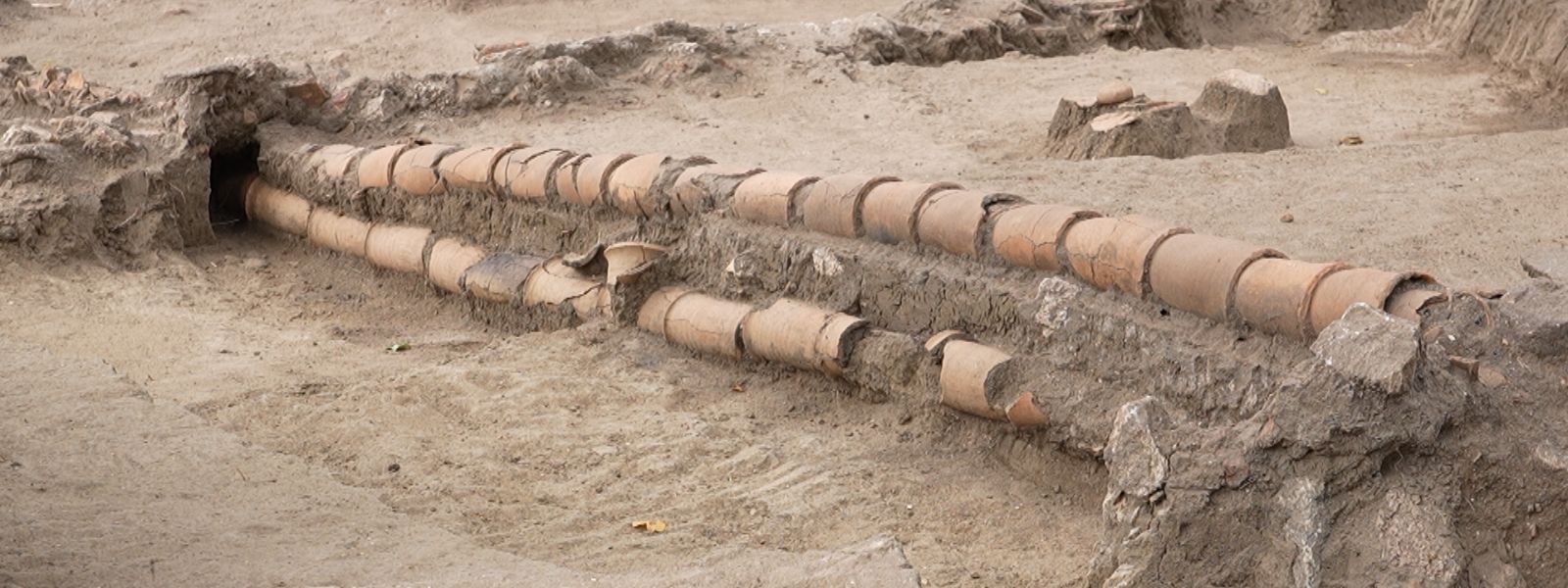
Rare Underground Clay Pipeline System Found at Sri Lanka’s Ancient Yapahuwa Kingdom



.png )
This report was produced for News 1st By Randhika Hettiarachchi
COLOMBO (News 1st); A major archaeological excavation at the ancient kingdom of Yapahuwa has uncovered evidence of what researchers believe to be a settlement inhabited by ordinary citizens, offering a rare glimpse into the daily lives of people who lived during one of Sri Lanka's most important historical periods.
While archaeological discoveries across Sri Lanka have frequently revealed monasteries occupied by Buddhist monks and palaces used by kings, evidence relating to where ordinary people lived has remained comparatively scarce. The latest findings from Yapahuwa are now shedding new light on that aspect of the island's history.
The rise of Yapahuwa as Sri Lanka's fourth kingdom was closely linked to the collapse of the Polonnaruwa Kingdom following the South Indian invasion led by Kalinga Magha. The invasion forced not only rulers but also large sections of the population to migrate to other parts of the island in search of safety.
Security subsequently became the primary consideration in establishing new capitals, leading rulers to select isolated rocky outcrops and naturally fortified locations for royal residences and the safeguarding of the Sacred Tooth Relic.
It was under these circumstances that Yapahuwa emerged as the country's fourth kingdom. Following the reign of King Vijayabahu IV, King Bhuvanekabahu I, who ascended the throne in the 13th century, established Yapahuwa as the royal capital.
Although the Yapahuwa Kingdom existed for only around 12 years, it evolved into one of the most secure and artistically remarkable capitals in Sri Lankan history. The kingdom was protected by formidable inner and outer fortifications, complemented by a dual moat system that enhanced its defenses.
Yapahuwa's world-renowned stone staircase and lion sculptures continue to be regarded as some of the finest examples of ancient Sri Lankan craftsmanship and architecture.
Seeking to uncover previously unknown aspects of the kingdom, the Central Cultural Fund launched a new archaeological excavation in 2025 under the leadership of Professor Mangala Katugampola.
The project has incorporated modern technology into archaeological research, with specialists utilizing LiDAR technology and Ground Penetrating Radar (GPR) techniques to examine the site.
Researchers selected the area between the inner and outer fortification walls of Yapahuwa for extensive horizontal excavations, leading to one of the most remarkable discoveries yet made at the site.
The excavation team has uncovered a unique underground clay pipeline system unlike anything previously discovered elsewhere in Sri Lanka. Archaeologists found three separate subterranean pipeline networks within the same structure, all running parallel to one another in the same direction.
Although previous excavations at Yapahuwa had unearthed foreign coins indicating international connections, researchers believe the latest findings could provide even deeper insights into Sri Lanka's social and urban history.
The excavation has also yielded a large collection of artefacts, including clay lamps, pottery fragments, pieces of Chinese porcelain, metal nails and numerous other clay-based objects.
According to Professor Katugampola, these artefacts do not appear to have been associated with monastic use, suggesting they may have belonged to ordinary residents who once lived within the ancient urban settlement.
Researchers believe the discoveries could fundamentally enhance understanding of Yapahuwa and reveal many previously unknown aspects of life within the medieval kingdom.
The findings are expected to contribute significantly to future studies of Sri Lanka's urban history, social structures and settlement patterns, providing rare evidence of how ordinary people lived alongside one of the country's most important royal capitals.
Other Articles
-857524_550x300.jpg)

-857512_550x300.jpg)
 (1)-857500_550x300.jpg)
-857493_550x300.jpg)


.png)


Featured News




News 1st, MTV Channel (Pvt) Ltd, MBC Networks (Pvt) Ltd, 45/3, Braybrooke Street, Colombo-02.
T.P : +94 114 792 700, Fax : +94 114 792 733
T.P : +94 114 792 700, Fax : +94 114 792 733




 |  | .webp) |
|---|---|---|
 |  |  |
 |  |  |
 |
