.webp)


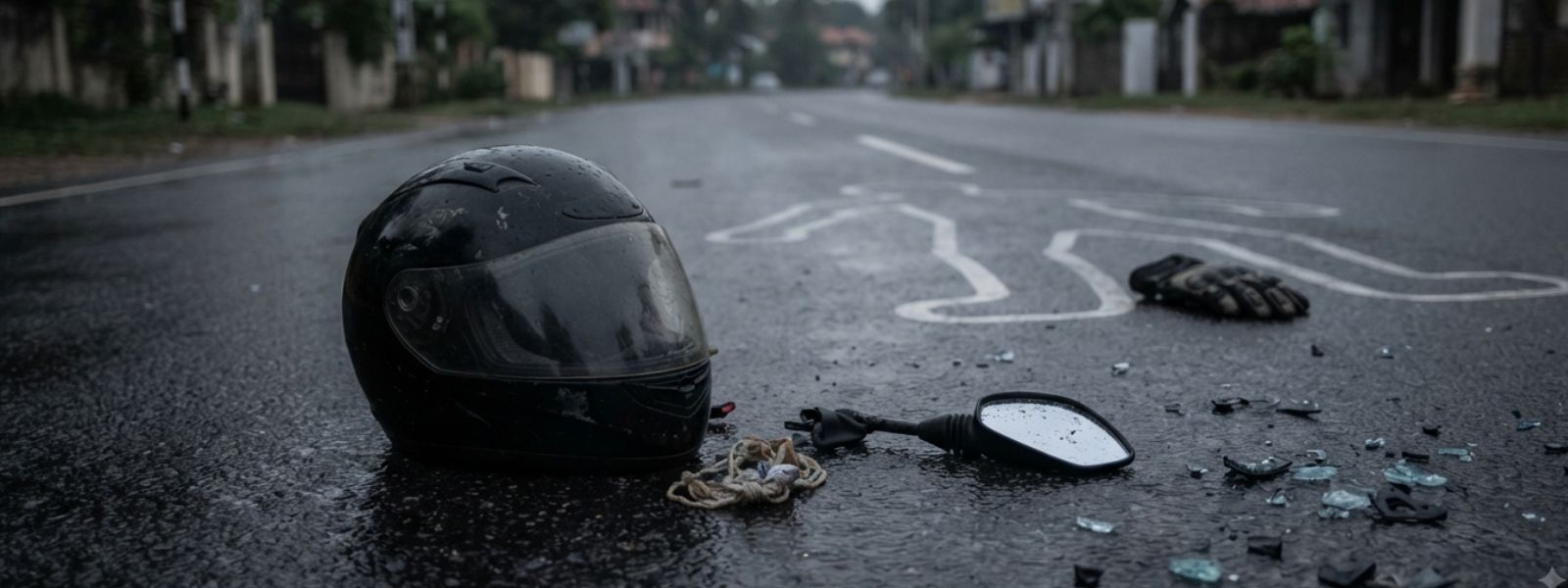
5.2 MILLION Motorcycles on Sri Lankan Roads, But at What Cost?



.png )
COLOMBO (News 1st); As motorcycle ownership reaches unprecedented levels in Sri Lanka, police are warning that the country's roads are witnessing a dangerous and often deadly consequence of the two-wheeled transport boom, particularly among young riders.
Deputy Inspector General of Police W.P.J. Senadheera of the Traffic Control and Road Safety Division says motorcycles have become the dominant mode of transport on Sri Lankan roads, but their growing popularity is also contributing to an increasing number of serious and fatal road accidents.
According to the DIG, Sri Lanka currently has more than 9.2 million registered vehicles, of which over 5.2 million are motorcycles. In other words, motorcycles account for well over half of all registered vehicles in the country.
The figures show a dramatic increase in motorcycle registrations in recent years. In 2024, around 65,289 motorcycles were registered out of a total of 74,410 new vehicles. In 2025, motorcycle registrations surged to 254,817 out of 362,100 total vehicle registrations. So far this year, nearly 398,538 vehicles have been registered, with motorcycles accounting for approximately 273,421 of that figure.
The statistics reveal a clear trend: motorcycles are being added to Sri Lanka's road network at an unprecedented rate.
Beyond traditional motorcycles, an additional 70,000 electric two-wheelers have also entered the transport system, further increasing the number of motorcycles competing for space on already congested roads.
According to police, this rapid increase is now emerging as a significant factor behind the rising number of motorcycle-related accidents across the country.
Senadheera noted that lightweight motorcycles, particularly affordable Indian-manufactured models, have become popular because they are economical, fuel-efficient and accessible to ordinary Sri Lankans.
These vehicles were originally intended to meet practical transportation needs. They allow people to travel to work, attend school, run daily errands and move between towns at a relatively low cost. Scooters have also become increasingly popular among women, while motorcycles have become a common family transport solution in both urban and rural areas.
However, police say a growing number of young riders are no longer using motorcycles solely for transportation.
Instead, many are using them for high-speed riding and risky road behaviour.
According to Senadheera, a significant number of accidents involve teenagers under 18 and young adults who push motorcycles beyond their intended limits.
He explained that many lightweight motorcycles become difficult to control when travelling at excessive speeds. In emergency situations, riders often attempt sudden braking only to lose control of the vehicle.
The DIG pointed out that the characteristics that make these motorcycles attractive, such as their lighter weight and fuel efficiency, can also become a disadvantage when they are ridden recklessly.
Police investigations into recent crashes have repeatedly identified excessive speed as a common factor.
Senadheera said OICs frequently contact him regarding fatal accidents, and many investigations reveal a familiar pattern. Riders travel at high speeds, suddenly apply the brakes, lose control of the motorcycle and are thrown onto the roadway. In many cases, victims then collide with oncoming vehicles or are run over by vehicles approaching from behind.
According to police, that sequence of events has become one of the most common causes of motorcycle fatalities.
The DIG stressed that motorcycles were introduced as a mode of transport and not as vehicles for racing or performing dangerous stunts.
He issued a direct appeal to young riders to avoid speeding and to use motorcycles responsibly.
Senadheera also raised concerns about a growing trend among parents, who increasingly purchase motorcycles as reward gifts for their children after examination successes such as the GCE Ordinary Level or Advanced Level examinations.
While such gifts are often given with the best intentions, he warned that the consequences can sometimes be devastating.
Recalling a recent case, the DIG spoke of a young rider currently receiving intensive care treatment after suffering a catastrophic motorcycle accident.
According to the information available to police, the teenager's father, who is employed in Italy, had purchased a motorcycle worth approximately Rs. 1.2 million as a reward for passing the Advanced Level examination.
Today, that young rider remains hospitalised with severe injuries.
"The child is unable to get up. The spine has been severely damaged and multiple major surgeries have been required," the DIG revealed.
Other Articles
-857524_550x300.jpg)

-857512_550x300.jpg)
 (1)-857500_550x300.jpg)
-857493_550x300.jpg)


.png)


Featured News




News 1st, MTV Channel (Pvt) Ltd, MBC Networks (Pvt) Ltd, 45/3, Braybrooke Street, Colombo-02.
T.P : +94 114 792 700, Fax : +94 114 792 733
T.P : +94 114 792 700, Fax : +94 114 792 733




 |  | .webp) |
|---|---|---|
 |  |  |
 |  |  |
 |
