.webp)


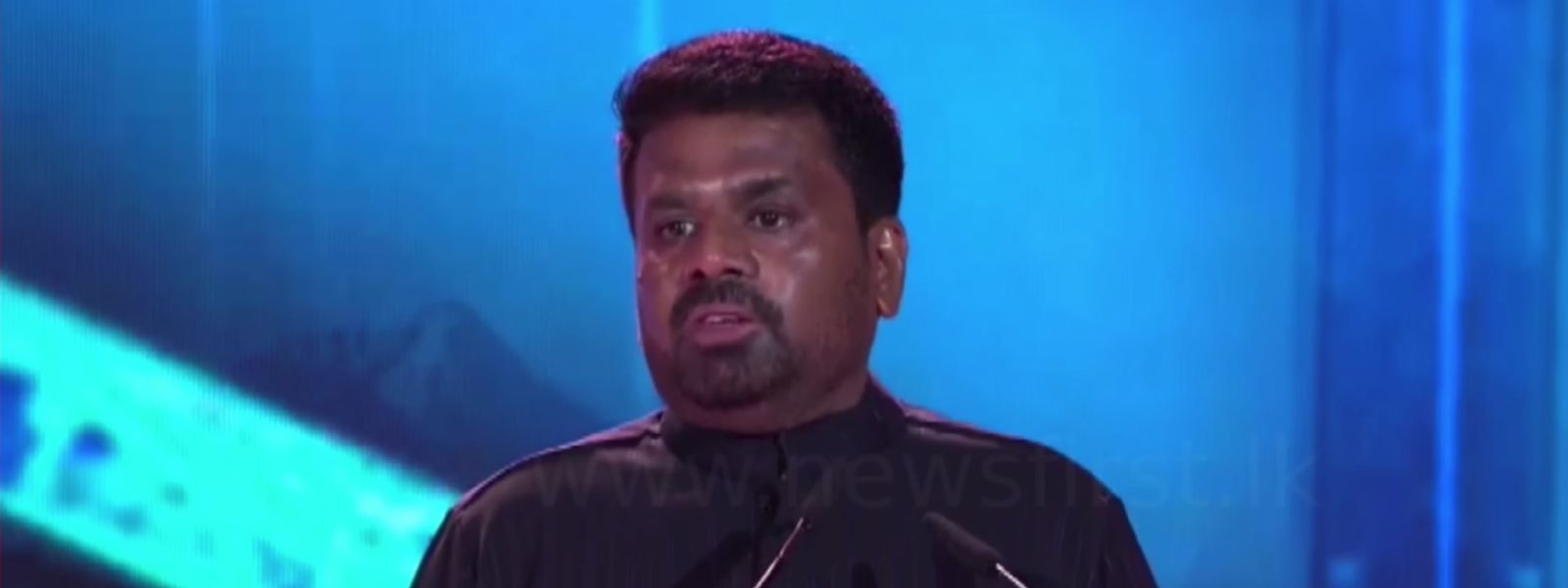
Sri Lanka Must Build an Economy Strong Enough to Withstand Any Shock



.png )
COLOMBO (News 1st); President Anura Kumara Dissanayake says Sri Lanka must rebuild an economy strong enough to endure both external and internal shocks, stressing that true stability is achieved only when the economy does not collapse in the face of disturbances.
He recalled that Sri Lanka has already faced several challenges: rising tensions between India and Pakistan as an external factor, the new tax policy introduced by the United States as another, and finally the internal shock known as Ditwah, which he noted caused the greatest internal economic damage in Sri Lankan history.
The President addressed public concerns regarding the government maintaining 1.2 trillion rupees in the Treasury account. He explained that it was necessary, especially considering that in 2022 the Treasury had an overdraft of 800 billion rupees, while by the end of last year it had a 1,200-billion-rupee deposit, now somewhat reduced but still essential.
These reserves, he said, allowed the government to manage benchmark interest rate controls, making the Treasury the largest account holder in the system and enabling the country to withstand internal shocks.
However, he warned that the country is now facing a major external shock, as a state of war centered in the Middle East has triggered serious disruptions to global supply chains.
At the beginning of March, oil was priced at 70 dollars per barrel, but has now risen to 100 dollars, a 42% increase, and continues to fluctuate unpredictably.
He said no one can trade confidently in such volatility, insurance costs have sharply increased, and some tenders are being cancelled due to global uncertainty. “Not only us, the whole world has become victims of this uncertainty,” he said.
The President also spoke about public behaviour, clarifying that he does not blame the people, as they suffered fuel and gas shortages in the past, with lives lost in queues.
Using the analogy that “a person burned once fears even the glowing ember,” he described how even a slight disturbance leads people to rush into queues and stockpile fuel.
He noted that diesel sales rose from 4,500 kilolitres on March 1 to 10,500 kilolitres on March 3, while petrol sales rose from 4,000 to 9,000 kilolitres, later reducing to 6,000.
He urged the public to understand that no individual can remain safe alone in such a situation, and that everyone must endure a little so the country can overcome the crisis together.
This external shock, he said, is affecting all, and that is why fuel prices had to be increased. He added that 57% of petrol distribution belongs to private companies while 47% is managed by external entities, all of whom require assurances. He stressed that the government must acknowledge their business interests and cannot rely solely on the CPC, as other players hold significant market share. The President said fuel consumption must return to normal levels, with diesel ideally returning to around 4,500 kilolitres, the usual consumption.
Reflecting on the 2022 crisis, he said it was not caused by global supply chain failures or destroyed oil reserves, but because Sri Lanka ran out of dollars to import fuel. Today, however, with 7.2 billion dollars in foreign reserves, any crisis would result from supply disruptions, not payment issues. He said the government is discussing alternative supply routes with partner nations and companies.
He stressed that the government’s responsibility is to ensure uninterrupted power supply, as failure would halt even the country’s major economic achievements. The President said discussions with the Central Bank Governor and relevant teams have concluded, focusing on necessary measures to maintain continuous energy supply.
He assured that uninterrupted power can be guaranteed for the next two months, but beyond that, forecasts lose meaning if the war continues.
All warring parties have stated they have not yet deployed their most powerful weapons, and already destruction is visible. Therefore, he said, no one, not even world powers, can predict what will happen if the war extends beyond two months.
He reaffirmed the government’s commitment to maintaining continuous energy supply, despite possible price fluctuations, and said all necessary mechanisms are being arranged.
The President added that some change in consumption patterns is essential. Nations facing crises have survived through adaptation, not by maintaining old habits. He urged the public to practice restraint and responsible economic behaviour.
“This is not about supporting the government,” he said. “This is so that all of us can rise together from this crisis.”
Other Articles
, Mr-830440_550x300. Rajeev Amarasuriya, Attorney-at-Law, 1)

-830428_550x300.jpg)
-830422_550x300.jpg)




Featured News

News 1st, MTV Channel (Pvt) Ltd, MBC Networks (Pvt) Ltd, 45/3, Braybrooke Street, Colombo-02.
T.P : +94 114 792 700, Fax : +94 114 792 733
T.P : +94 114 792 700, Fax : +94 114 792 733




 |  | .webp) |
|---|---|---|
 |  |  |
 |  |  |
 |
