.webp)


Polluted Air Drift From India Plummets Sri Lanka’s Air Quality



.png )
COLOMBO (News 1st); A surge of polluted air drifting from India has pushed air quality in several Sri Lankan districts to unhealthy levels, prompting fresh warnings from experts.
The National Building Research Organisation’s (NBRO) Air Pollution Management Unit confirmed that air quality has deteriorated sharply across the island due to transboundary pollution.
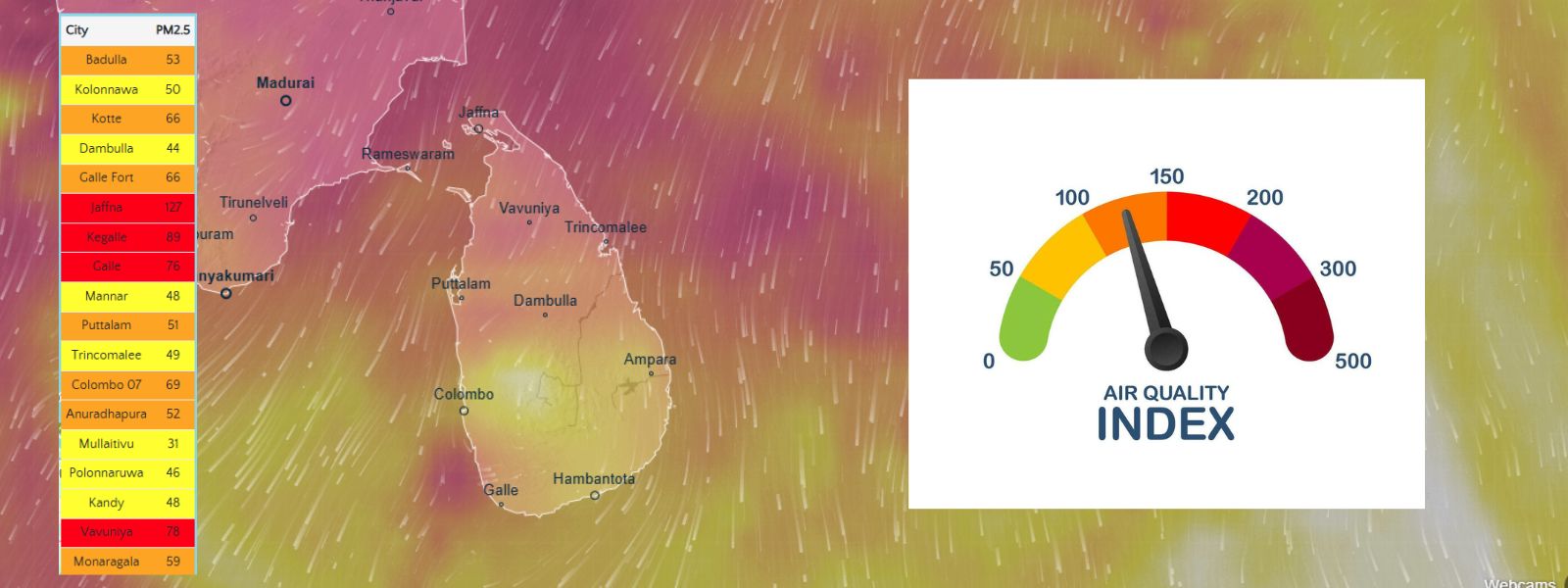
Chief Scientist Sarath Premasiri said polluted air masses entering Sri Lanka from the Indian subcontinent have created elevated PM2.5 concentrations, particularly in the northern, central, and western regions.
According to the Air Quality Index (AQI), several districts recorded unhealthy levels:
Jaffna – 138 (Unhealthy)
Kegalle – 86 (Moderate–Unhealthy for Sensitive Groups)
Vavuniya – 79
Galle – 76
These readings, displayed vividly in the uploaded Dynamic Air Quality Map, show deep red and orange zones—indicating widespread degradation in breathable air.
The map also shows worrying PM2.5 levels in several cities nationwide:
Badulla
Colombo
Kolonnawa
Kotte
Monaragala
Puttalam
Trincomalee
Anuradhapura
Many of these areas fall into the yellow, orange, or red categories, signaling harmful air quality for the general population and particularly risky conditions for vulnerable groups such as children, elders, and those with respiratory conditions.
The institution stressed that everyone must remain vigilant until conditions return to normal.
What should I do when the air pollution becomes severe or hazardous ?
These are the recommendations from the World Health Organization.
Remain indoors as much as possible.
Avoid prolonged or heavy exertion outside.
Prevent additional sources of air pollution indoors.
Pay particular attention to keeping the rooms inside homes clean.
Limit and if possible unnecessary travel by cars, scooters and other motorized vehicles.
Create a clean room for sleeping particularly for young children or elderly persons.
Other Articles

-823812_550x300.jpg)
-823806_550x300.jpg)


-823782_550x300.jpg)






Featured News
-822734_550x300.jpg)
-822716_550x300.jpg)
-822495_550x300.jpg)
-819380_550x300.jpg)

News 1st, MTV Channel (Pvt) Ltd, MBC Networks (Pvt) Ltd, 45/3, Braybrooke Street, Colombo-02.
T.P : +94 114 792 700, Fax : +94 114 792 733
T.P : +94 114 792 700, Fax : +94 114 792 733




 |  | .webp) |
|---|---|---|
 |  |  |
 |  |  |
 |
